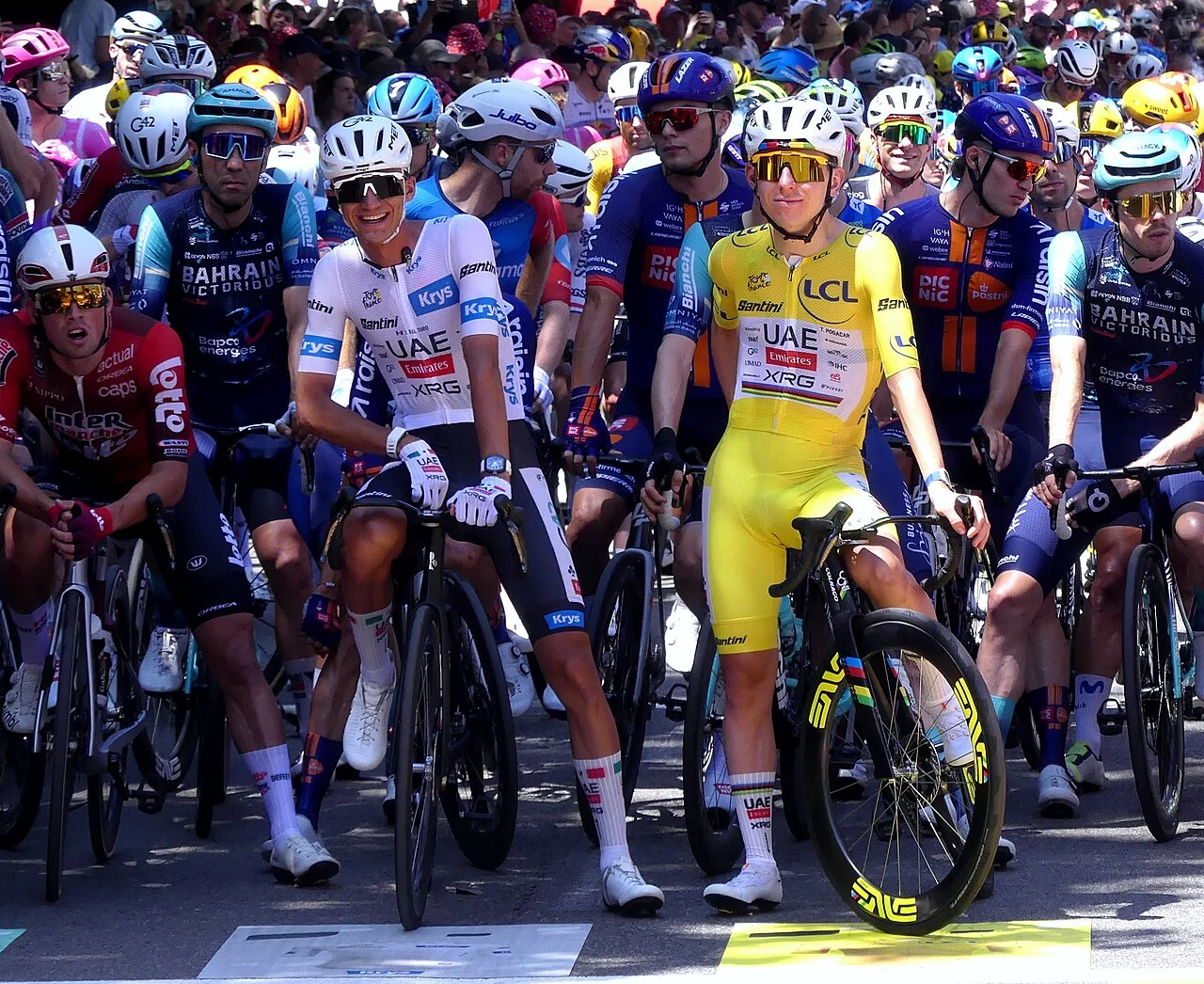
Tadej Pogačar would be more than welcome at the 2027 Giro d’Italia, but the route was not designed to attract him. So said Luca Guercilena, the new cycling director of RCS Sport, in a video interview published after the presentation in Rome on 3 November. For him the Slovenian is the man of the moment and his presence would be good news. But the race, he says, has a different idea.
The 110th edition starts from Trieste on 8 May and finishes in Rome on the 30th, after 3,418.9 km and 50,250 m of climbing. Pogačar, who won the Giro in 2024, has already indicated that he prefers the Tour and the Vuelta for 2027. The route, with its time trials, summit finishes and a double Mortirolo, is made for all the big names, not for just one.
Guercilena presents a balanced Giro for real riders
The Giro, says Guercilena, is well balanced. The mountain stages are important and hard, but they alternate with easier stages and time trials, so anyone, whatever their qualities, has their chance. The aim is to attract top-level riders, not a single name.
The director talks of a Giro designed for real riders, with iconic, legendary climbs. He hopes that stages such as the one to Aprica, with the double Mortirolo and the Gavia, and the Zoncolan stage will inspire riders to write those names into their palmarès. The Aprica stage, he adds, is a gift to the fans.
The welcome for Pogačar sits within this design; it does not change it. If the Slovenian decided to come he would be gladly received, but the route was not made for him.
The two stages in Slovenia are for Slovenian fans
There are two stages on Slovenian soil. The first starts there and finishes in Trieste, crossing the border; the second, from Ljubljana to Koper, is run entirely in Slovenia. It is the fourth time in the Giro’s history that a stage has started in Slovenia.
Many read them as a way of bringing Pogačar to the Giro for a second time, three years after his triumph in 2024. Guercilena plays down the idea: those stages, he says, are made mainly for Slovenian fans. What counts is the proximity to Italy and to Friuli Venezia Giulia, a region with a central role in the 2027 Giro, and the fact that Slovenia now produces many champions.
Pogačar gladly races at home: he has won the Tour of Slovenia twice and had to miss the 2026 European Championships in Ljubljana. The second stage, 166 km with a sharp climb at Markovec in the last 5 km, is designed for a fast finish.
Pogačar looks to the Tour and the Vuelta for 2027
He would prefer the Giro, Pogačar said, but sooner or later the Vuelta has to go in the trophy cabinet and that will be next year’s goal. He knows the Giro: in 2024 he won the overall on 26 May and the Tour on 21 July, a double that is extremely rare in cycling today.
2026 was his richest year for Classics: he won Strade Bianche, Milan-San Remo, the Tour of Flanders and Liège-Bastogne-Liège, then the Tour de Romandie and the Tour de Suisse, and on 26 July his fifth Tour de France. In all, that makes 22 victories. He finished second at Paris-Roubaix.
The Vuelta, however, got away from him. In the 2026 edition he was leading when he crashed on stage 8, on 29 August, and abandoned. The unfinished business with the Spanish race explains the 2027 choice more than any route.
The 2027 Giro has 57 km of time trials and seven summit finishes
There are two time trials, totalling 56.9 km: 57 km against the clock, of which 19 uphill. The rest days are 17 and 24 May. There are seven summit finishes, which become eight counting the uphill time trial. Stage 16 is the queen stage, and stage 20 takes the Giro up the Zoncolan.
Ten years after the first Grand Tour won by Tom Dumoulin, at the Giro itself, the route opens the door to a time-trial specialist. But the mountains, from the first week to the last, leave only the most complete riders at the front.
The comparison with the 2027 Tour de France clarifies the design. The Grande Boucle has 71 km of time trialling, the highest total since 2012, and three summit finishes against five in 2026. The Giro has about 14 km less of time trials and more finishes at altitude: it is a route tilted further towards the climbers.
The uphill time trial at Campo di Giove comes after six stages
The Sulmona–Campo di Giove, stage 7 on 14 May, measures 19.6 km. The first 7.1 km are easier, then come about 12 km at around 5% on average. It is not a climb for attacks: it is a long effort, where what counts is the pace you can hold to the top.
It comes after an opening in which the Giro has already shown the mountains. On 12 May, in stage 5, there is the first real taste, and a time trial uphill immediately puts the riders face to face with their legs.
Sassotetto, Monte Livata and Due Santi: the climbs of the first half
Sassotetto is the first summit finish
Stage 5, Filottrano–Sarnano-Sassotetto, is 139 km with 3,300 m of climbing. The final climb measures 13.1 km, averaging 7.4% with ramps of 14%. It is the first summit finish of the Giro.
On 16 May, in stage 9, comes Monte Livata: 13.9 km at an average of 6.9%, the gentlest of the three climbs of the first half. The day before, stage 8 from Trasacco to Naples, 219 km, ends with an undulating final 30 km.
Zeri and Piani di Bobbio close the second week
On 20 May, in stage 12, the race finishes at Zeri on the Passo dei Due Santi, tackled for the first time: 8.7 km at an average of 8.7%, with a maximum of about 13%. It is the Bartali stage, and the climb is short but hard.
On 22 May, in stage 14, the race starts in Cantù and finishes at Piani di Bobbio/Valtorta after 187 km and 4,900 m of climbing. Before that come the Ghisallo, the Culmine di San Pietro, the Miragolo San Salvatore and the Alino. The final climb is 10.1 km at an average of 9%, steeper than Zeri.
Few sprints remain for the fast men, and a time trial in Milan
Among the stages not designed for the general classification, there are six to eight opportunities for those not fighting for the pink jersey. For pure sprinters, though, the room is shrinking: uphill kicks and finishes with late climbs give ground to the attackers and the breakaway men.
The cleanest sprint is on stage 4, on 11 May, at Argenta–Misano Adriatico, on the Marco Simoncelli circuit. Another is in Reggio Emilia, on 21 May, and the third at Vo’, after the Chiari–Vo’ of 194 km, almost all flat.
On 23 May, in stage 15, comes the 37.3 km Monza–Milan time trial, starting from the Autodromo Nazionale. It is flat, and it arrives on the eve of the hardest week.
Mortirolo twice and the Gavia: stage 16 is the queen stage
On 25 May, in stage 16 from Sondrio to Aprica, the Giro offers 192 km and 5,700 m of climbing. The race climbs the Mortirolo twice, with the Gavia in between.
The Mortirolo measures 12.8 km at an average of 10.1% with gradients up to 12%. The Gavia is longer and less steep: 16.5 km at 8%, with the summit at 2,618 m, the Cima Coppi and the highest point of the 2027 Giro. The Giro has not used the Gavia road since 2014.
The last Mortirolo comes 33.3 km from the finish. It is a climb the Giro knows well: it has climbed it 17 times, the first in 1990 with Monno, while the Gavia appears for the tenth time since 1960.
Madonna di Campiglio and Zoncolan: the Giro ends uphill
Madonna di Campiglio is the last chance before the Zoncolan
On 27 May, in stage 18, the race goes from Rovereto to Madonna di Campiglio: 154 km, 4,500 m of climbing and five categorised climbs. The finish comes after 12.5 km at an average of 5.7%, less steep than the climbs seen before.
In between, stage 19 from Rovereto to Sacile (199 km and 3,000 m of climbing) leaves room for those who attack from far out.
The Zoncolan decides the Giro on 29 May
On 29 May, in stage 20, the race starts in Pordenone and finishes on Monte Zoncolan after 180 km: it is thelast summit finish of the Giro. The climb is from the Ovaro side, from 530 to 1,730 m in 10.1 km, with an average of 11.9% and a maximum of 22%. It is the eighth finish on the Zoncolan in the Giro’s history.
In the last 50 km come the Passo Duron and Sella Valcalda, which land on the legs before the final wall. Winners here have been Simoni (2003 and 2007), Basso (2010), Antón (2011), Rogers (2014), Froome (2018) and Fortunato (2021).
Vingegaard and Evenepoel face a Giro for climbers
Jonas Vingegaard won the 2026 Giro. At the 2026 Tour de France he abandoned on stage 15, 4’30” behind Pogačar.
Remco Evenepoel is the name the organisation hopes to bring to the start. In 2026, in his debut with Red Bull-Bora-Hansgrohe after leaving Soudal Quick-Step, he finished the Tour de France second behind Pogačar, with two stage wins, including the summit finish at the Plateau de Solaison. He last rode the Giro in 2023: he abandoned with COVID-19 while wearing the pink jersey.
On 9 October 2026, speaking about the 2027 Giro, he said the door is open, that he will look at the route and decide in the winter whether to enter. That route now exists: two time trials, one of them uphill, and mountains from the first week to the third.
Pogačar’s decision comes in December
Pogačar says he still needs time to work out what he wants to do next year. The decision in December, at the team’s second training camp, will be the final one. For now his stated programme is the Tour de France and the Vuelta.
The Giro starts from Trieste on 8 May. Before that come the December camp and the winter, when the Slovenian and Evenepoel will make their choice.
News written with the help of Mnemosyne.
Sources
- Cyclingnews, «’Tadej Pogačar is more than welcome’ says Giro d’Italia director, but Slovenian stages not designed to lure the five-time Tour de France champion».
- Cyclingnews, «Giro d’Italia 2027 route revealed – A climber’s paradise with double Mortirolo ascent and return to iconic Monte Zoncolan and Passo Gavia».
- Domestique, «Giro d’Italia 2027 route – Stage-by-stage guide».
- Giro d’Italia (RCS Sport), «From Trieste to Rome: Giro d’Italia 2027 Route Unveiled».
- WielerFlits, «RCS-baas Luca Guercilena nodigt Tadej Pogacar uit voor Giro d’Italia».
- Photo: Florian Pépellin, CC BY-SA 4.0, via Wikimedia Commons.
