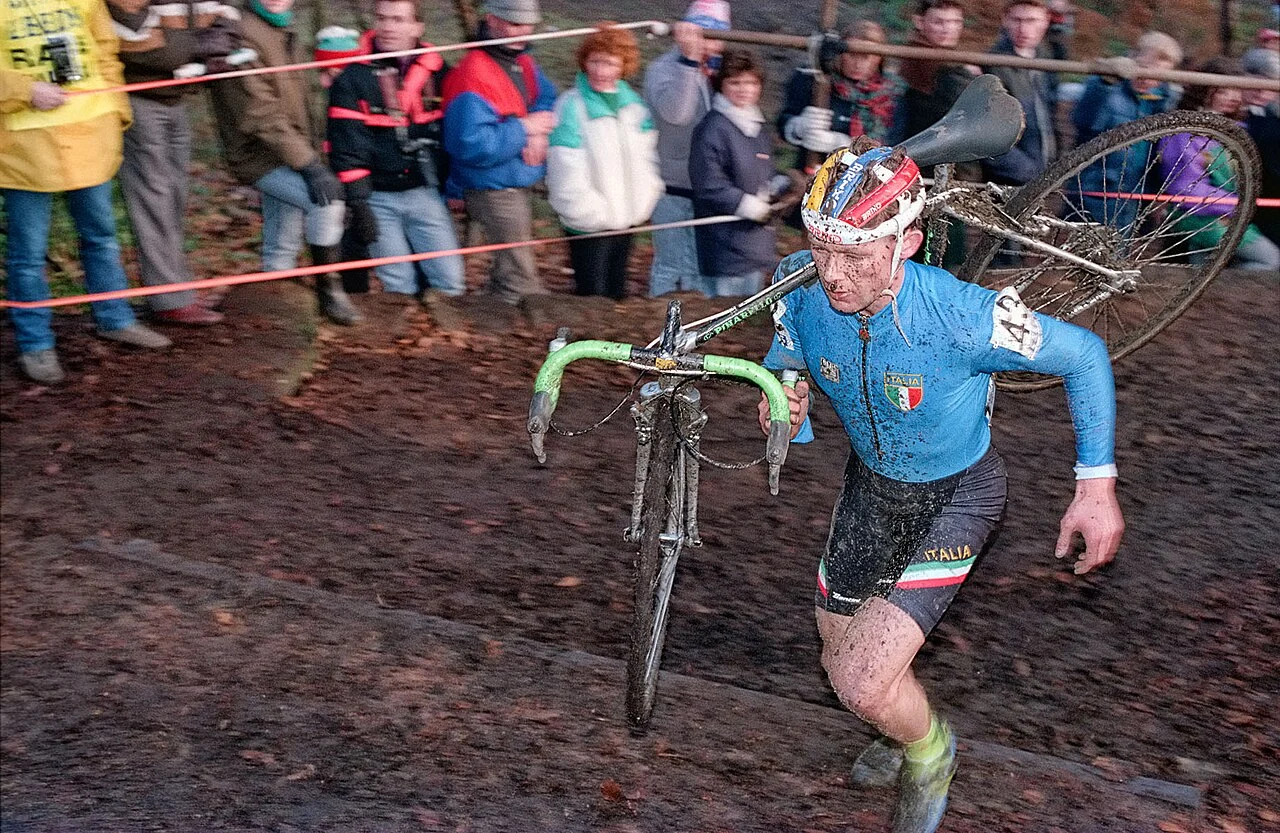
Daniele Pontoni became elite world champion of cyclo-cross at the World Championships in Munich on 1 and 2 February 1997, on a circuit that started and finished inside the Olympic Stadium. The man from Friuli went clear on the second of seven laps and finished alone in 1h00’40”. He had 23” on Switzerland’s Thomas Frischknecht and on Luca Bramati, the other Italian, who finished third. Two Italians were on the podium, and one stood on the top step: Italy had not known a World Championship like it since the Sixties.
Munich’s Olympic Stadium hosts the cyclo-cross World Championships
Munich had already brought cyclo-cross into its Olympic Stadium in 1985, and twelve years later it made the same choice. Racing started and finished in the stadium, and in between lay a 3.2 km loop that climbed and dropped through the hills of the Olympiapark. It was a technical course, with climbs, sections to run on foot and difficult ground from one end of the lap to the other. Over two days the titles were awarded to the juniors, the Under 23s and the elite riders. 21 national federations took part, and about 35,000 spectators gathered around the course.
The home crowd, however, had to do without the name they were waiting for. Mike Kluge was sidelined by injury: the former world champion, the rider the organisers had banked on, could not start, and the elite race got under way without him. In the end the best of the Germans was Franz-Josef Nieberding, seventh. On the podium of the senior race stood two Italian jerseys and a Swiss one instead, and the first of the Italians had come a long way, along a path of medals that began six winters earlier.
Daniele Pontoni arrives in Munich with four world medals
Pontoni was born in Udine on 8 September 1966 and arrived in Munich aged thirty, with a long world-level career behind him. He had won his first medal among the amateurs, a bronze at Gieten in 1991. The following winter, at Leeds, he had won the amateur world title, and in 1993, at Corva, he had returned to the third step of the podium. That made three World Championships in a row and three podiums, with a gold in the middle.
His first medal among the elite had come at Montreuil, in 1996: a silver, behind only the Dutchman Adrie van der Poel. Meanwhile he had been Italian elite champion since 1994. In Munich, then, the man from Friuli was no surprise to be discovered. He was the man who twelve months earlier had had only one rival ahead of him, and that rival was at the start again, with the title to defend. In the meantime, behind Pontoni, another Italian had grown into a winner of the standings that last the whole winter.
Luca Bramati, 1995-96 World Cup winner
Alongside Pontoni in the Italian jersey was Luca Bramati, born in Vaprio d’Adda on 6 November 1968, two years younger than the man from Friuli. In the winter of 1995-96 he had won the cyclo-cross World Cup and, in the same season, the Superprestige. These are the two standings that reward those who go well for months, from one Sunday to the next, and not only on World Championship day. That season he had also taken the one-day prize: at Montreuil he had climbed onto the podium alongside Pontoni, in third.
Italy, then, went to Munich with two men who had both finished in the top three of the World Championships the year before. It was a situation the Italian team had not known since the days of Renato Longo and Amerigo Severini. One of them had the silver and the other the World Cup, and both already knew the road to the podium. For Bramati, at the senior World Championships, that podium was worth a bronze up to then; in Munich he would take a second, and for silver he would miss out only in the sprint.
Van der Poel, Runkel and Frischknecht are the Italians’ rivals
In those years the title did not stay long in the same country. In 1994 it had been won by Belgium’s Paul Herygers and in 1995 by Switzerland’s Dieter Runkel. In 1996 it had gone to the Dutchman Adrie van der Poel, who in Munich was the reigning champion and started with the rainbow jersey on his shoulders. And the 1995 champion was in the race again, ready to fight for the title with the man who had taken it after him.
Switzerland brought to Munich Runkel himself, Beat Wabel and Thomas Frischknecht. With Van der Poel, among the Dutch, was Wim de Vos, while Belgium’s riders included Peter Van Santvliet and Erwin Vervecken. Vervecken would be world champion four years later, but in Munich nobody could know it. By the end of the day these names would share the top ten places with the two Italians and with the German Nieberding: five nations in all, with three Swiss.
Pontoni goes clear on the second of seven laps
The elite race was run over seven laps of the Olympiapark loop, and the first scene was written by the Italians. At the start Pontoni and Bramati went out hard and took the lead. Behind them, in the scramble of the start, Frischknecht and the reigning champion Van der Poel lost places exactly where, in a cyclo-cross, the first measure of the opposition is taken. So, while the two Italians held the front, the Swiss and the Dutchman were already forced to chase.
Pontoni did not wait. He attacked as early as the second lap, with more than five circuits still to go, and from that moment the race had one man in front. Lap after lap he carried his advantage to the stadium, where he finished in one hour and forty seconds of racing, and he held it also thanks to a few mistakes by those chasing him.
Frischknecht catches Bramati and beats him in the sprint
A different race was run for the other two medals. Frischknecht, left behind at the start, caught Bramati midway through the race, and in the end beat him: he won the sprint and took silver, while Bramati had the bronze. Both finished 23” behind Pontoni.
Between Bramati and fourth place there were twelve seconds. Fourth was Van der Poel, the reigning champion, who after the difficult start finished 35” down. Behind him came the other Dutchman, De Vos, and the first Belgian was only sixth: Vervecken, a little over a minute back. Then came Nieberding, Wabel and Runkel, the last two together, and in tenth Van Santvliet, about two minutes down. No Belgian, that day, made the top five.
Toffoletti, Nys and Wellens: Italy tops the medal table
In Munich the Italians did not reach the podium only with the seniors. The junior Stefano Toffoletti was second, 5” behind Switzerland’s David Rusch. In the Under 23 race, won by Belgium’s Sven Nys ahead of his compatriot Bart Wellens and France’s Christophe Morel, Elvis Zucchi finished sixth.
With Pontoni’s gold, Toffoletti’s silver and Bramati’s bronze, Italy finished top of the medal table. Belgium and Switzerland took two medals each, a gold and a silver apiece, while France and Germany had one bronze each.
In that Under 23 race there was also a part of what was to come. The two Belgian riders on the podium would, within a few years, take over the senior title: Wellens won it in 2003 and 2004, Nys in 2005. The same weekend in which Italy won the elite World Championships showed, one category down, the names of Belgian cyclo-cross in the following decade.
Before Munich, Italy had Renato Longo’s five golds
Before Munich, Italy had had only one elite cyclo-cross world champion, Renato Longo. He had won the title five times between 1959 and 1967, and to his palmarès he had added two silvers and a bronze, the last in 1969. In the same years there had been Amerigo Severini, silver in 1958 and three times bronze. At two of those World Championships, in 1959 and 1965, the pair had stood on the podium together: Longo on the top step and Severini on the third.
After Longo’s bronze, however, the elite podium had remained without Italians for more than a quarter of a century, until the silver and bronze at Montreuil. So in Munich Pontoni became the second Italian to be world elite champion, thirty years after Longo’s last gold. With him on the podium was also Bramati, and for the fourth time two Italians stood in the top three of the same senior World Championships, as in 1959, in 1965 and the year before in France.
After Munich: Pontoni national coach and the 2027 World Championships in Ostend
In the following years the title passed to Belgium and the Netherlands: Mario De Clercq won it in 1998 and 1999, Richard Groenendaal in 2000. It was at Sint-Michielsgestel, at Groenendaal’s World Championships, that Pontoni finished ninth, 2’22” down. De Clercq came second and Nys third: the lad who had won the Under 23 race in Munich was already on the senior podium. In Italy, meanwhile, the man from Friuli carried on winning, and his elite titles in the end numbered ten, from 1994 to 1997 and then from 1999 to 2004.
The elite podium saw an Italian again ten years after Munich, with Enrico Franzoi’s bronze in 2007 at Hooglede-Gits. Pontoni, meanwhile, had crossed to the other side of the barrier: in July 2021 he was appointed national team coach for cyclo-cross, the same jersey in which he had won at the Olympiapark.
The next World Championships will be run at Ostend, in Belgium, from 29 to 31 January 2027, five days after the last World Cup round, at Hoogerheide on 24 January. Thirty years will have passed since the race in which two Italians started ahead of everyone and one of them stayed there all the way to the stadium.
Written with the help of Mnemosyne.
Sources
- Wikipedia (German), “Cyclocross-Weltmeisterschaften 1997”.
- Wikipedia (French), “Championnats du monde de cyclo-cross 1997”.
- Wikipedia (Italian), “Daniele Pontoni”.
- Wikipedia (English), “Luca Bramati”.
- Wikipedia (English), “UCI Cyclo-cross World Championships – Men’s elite race”.
- Photo: Brian Townsley, CC BY 2.0, via Wikimedia Commons.
