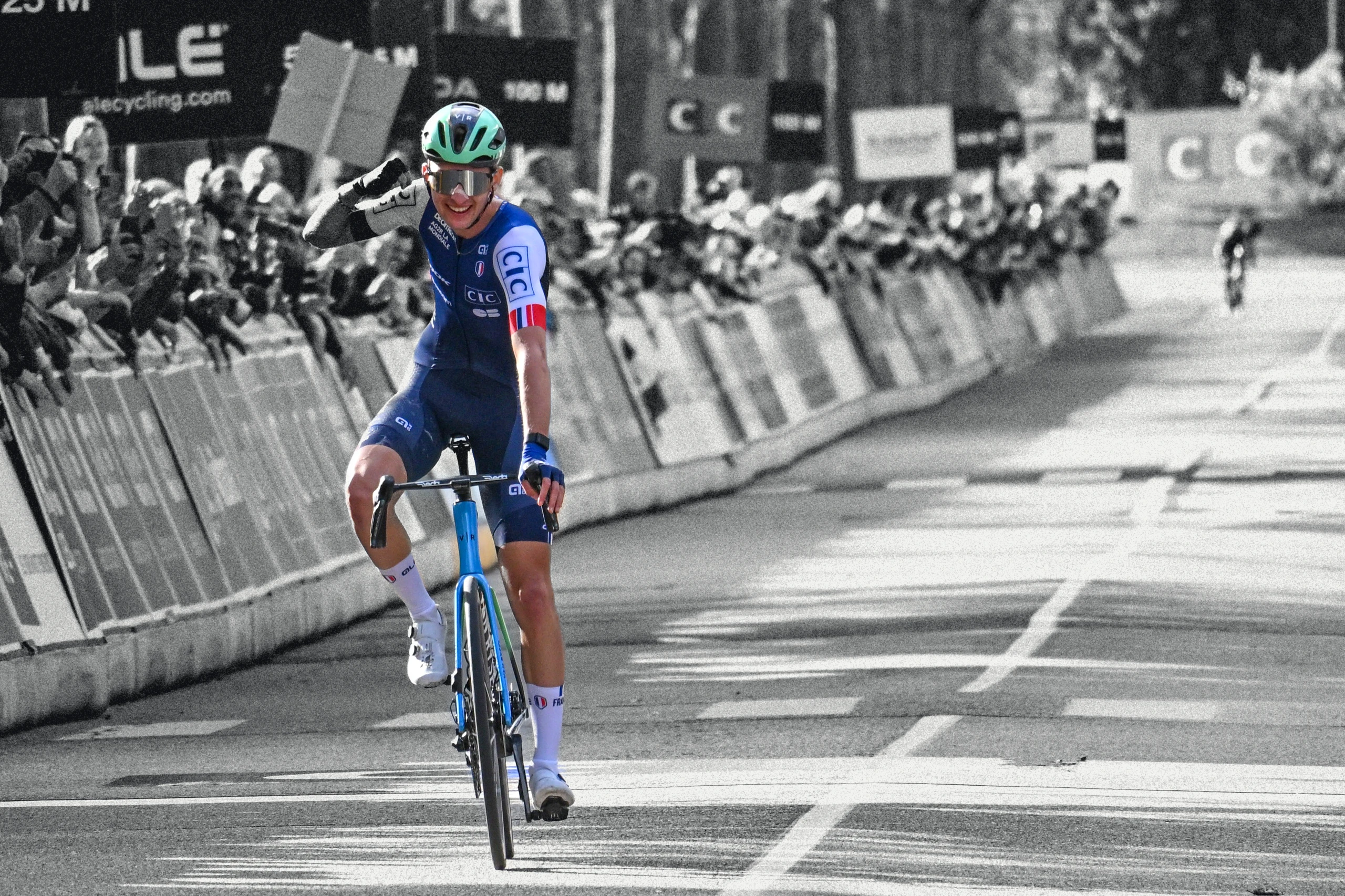
Luca Guercilena has started early in courting the champions for the 2027 Giro d’Italia. The Chief Operating Officer & Cycling Director of RCS Sports & Events, the company that organises the Italian race, told Domestique that Paul Seixas, Isaac Del Toro, Remco Evenepoel and Jonas Vingegaard would have a good chance of winning the Giro, and that all four would do well to think carefully about their Grand Tour goals for 2027. It is an invitation, and the name he most wants is Seixas, the twenty-year-old Frenchman of Decathlon CMA CGM who won Il Lombardia on 10 October.
None of the four has said yes so far. The final programmes are announced in December, at the training camps and team presentations, and for Seixas the choice is not just between the Giro in May and the Tour de France in July: at the end of August the World Championships are in the French Alps. To persuade them, Guercilena puts on the table a route with two time trials and seven summit finishes, and a portrait of the rider who can win it.
The 2027 Giro is for those who time trial well and can defend themselves in the mountains
Guercilena’s reasoning starts with Tadej Pogačar. The Slovenian won the Giro in 2024 and RCS had hoped to see him back in Italy after two years away, but his return in 2027 is not in the plans. Everyone knows, says Guercilena, that Pogačar often dominates races and will in all likelihood dominate the 2027 Tour too: for that reason some talented riders may make a different choice and really go for the Giro. Anyone who prefers to finish third, fourth or fifth in another race, he adds, has a problem of their own. At the 2026 Tour, Del Toro finished third and Seixas fourth.
Hence the invitation. The 2027 Giro, says Guercilena, is designed for a rider who goes well in the time trials and can then defend himself in the mountains, and it is a great race for anyone looking to win their first Grand Tour. The description fits Seixas and Del Toro, general classification riders who have yet to win a three-week race. It is also a progressive race, he explains, in which a GC contender cannot show his hand and go deep too early, because the last week is hard; but he cannot wait too long to attack either. His is a message aimed at young riders, who in July would find a Tour with more time trial kilometres and fewer summit finishes, and who are building their season right now.
The route of the 2027 Giro d’Italia from Trieste to Rome
The route was presented in Rome on 3 November 2026, and the race will finish there. The 110th edition of the Giro d’Italia starts on Saturday 8 May and ends on Sunday 30 May, from Trieste to Rome: twenty-one stages over 3,418 km, from the eastern border to the capital. There are two rest days, Monday 17 and Monday 24 May, and they split the race into three blocks: nine stages to Monte Livata, six to the Milan time trial, and another six from the Aprica queen stage to Rome.
Total elevation gain is 50,250 m, more than the 2026 Giro won by Vingegaard and less than the 2025 edition won by Simon Yates. It is therefore not the hardest Giro of recent years, but nor is it one that lets the GC men relax: the climbs are not all at the end, they come from the first week, and there are few pure flat days for the sprinters. It is a design that rewards the complete rider over the pure climber or the time trial specialist, which is exactly the profile Guercilena describes.
Seven summit finishes, four more than the 2027 Tour
There are seven summit finishes, four more than the 2027 Tour de France, which has three. Vincenzo Nibali, who won the Giro twice and read the route for IDLProCycling, notes that there are no longer three big mountain stages in a row as there once were, but that the difficulties are spread more evenly. It is the progressive race Guercilena talks about: the general classification moves from the start, but the reckoning comes at the end.
The first test comes on the fifth stage, at Sassotetto, the first summit finish, new to the Giro: 13.1 km at 7.4%, enough to show who turned up in Trieste in form. Two days later comes the Campo di Giove uphill time trial, which is a story of its own, and the first week ends on the ninth stage at Monte Livata, 13.9 km at a gentler gradient. Nibali feels it is a home climb, because his wife is from Fiuggi, and he describes it as long, with gradients that are anything but impossible, one of those on which you pick up speed and build an advantage.
The second week takes the race into the Apennines and then towards Lombardy. On the twelfth stage the finish is at the Passo della Futa, at Due Santi, after 8.7 km at 8.3%; on the fourteenth it is at Piani di Bobbio, the steepest climb so far, at the end of a day with almost 5,000 m of climbing. It is the eve of the Milan time trial: whoever arrives in Monza with a deficit knows they can win some of it back there, or lose even more.
The Giro time trials: 56.9 km against the Tour’s 71
There are two time trials, and they are not alike. The first is the seventh stage, from Sulmona to Campo di Giove: 19.6 km, of which 12.5 are uphill at 4.4%. It is a rideable gradient, on which you go fast, but long enough that the flatland specialist cannot live on raw power alone: a light rider who holds the watts per kilo for more than half an hour loses little, or gains.
The second is the Monza-Milan time trial of the fifteenth stage, 37.3 flat km, the last chance for the strong time triallists before the rest day and the final week. Position on the bike counts here, as does power held over a long effort, and the time triallist can put between himself and the climbers a margin to defend later in the mountains. Together the two tests add up to 56.9 km, more than in the previous two Giri, yet the flat kilometres against the clock are the fewest in years; the 2027 Tour has 71 km of time trialling.
Nibali knows how much a climbing time trial can weigh: in 2016 he lost more than two minutes to Steven Kruijswijk in an uphill time trial. If things don’t go right in a test like that, he says, you lose a lot of time. For the rider Guercilena describes, the one who goes well against the clock and can defend himself when the road goes up, Campo di Giove is instead the afternoon to bank an advantage before the real mountains.
The final week goes through the Mortirolo, Gavia and Zoncolan
The 2027 Giro is decided after the last rest day. The Milan time trial closes the second week on Sunday 23 May, Monday is free and on Tuesday 25 the riders set off again on the queen stage finishing at Aprica: 192 km and 5,700 m of climbing. The Mortirolo, climbed twice, 12.8 km at 10.1%, opens and closes the day, and in between comes the return of the Gavia, 16.5 km at 8% up to 2,600 m, the Cima Coppi of this edition. Nibali calls it the true queen stage: a day that gives no respite, brutal, perhaps decisive.
The queen stage opens a week with two more mountain stages. The eighteenth finishes at Madonna di Campiglio after 4,450 m of climbing; the twentieth ends on Monte Zoncolan, 10.1 km at 11.9%, at the end of a day that climbs 3,600 m in the last 50 km. The next day the Giro arrives in Rome, and the Zoncolan is the last chance to change the general classification.
That is why Guercilena describes his Giro as a race that grows day by day. Whoever gains in the two time trials will have to defend that margin over three stages that come when two weeks of fatigue have already built up; whoever climbs best will have to choose the moment to attack, without burning out before Aprica and without waiting too long for the Zoncolan.
Isaac Del Toro: second at the 2025 Giro, third at the 2026 Tour
Isaac Del Toro, a Mexican born on 27 November 2003, already knows the Giro. In 2025 he finished second overall, won stage 17 and the young riders’ classification. He ended that season with 18 victories, and in the autumn he was the master of the Italian races: in a little over a month he won the GP Industria & Artigianato, the Coppa Sabatini, the Giro dell’Emilia, the Gran Piemonte and the Giro del Veneto.
In 2026 UAE Team Emirates XRG took him to the Tour, and Del Toro finished third overall. His wins fell to 12, but they came in bigger races: the overall at the UAE Tour in February, at Tirreno-Adriatico in March and at the Tour Auvergne-Rhône-Alpes in June, then the Grand Prix Cycliste de Montréal in September. In the spring he had also been third at Strade Bianche.
On a route like the 2027 one, though, another result counts above all. At the World Championships in Montréal Del Toro was fifth in the road race and sixth in the time trial, after fifth against the clock the year before: the time trials do not keep him out of the fight for a Grand Tour. The 2027 Giro has fewer time trial kilometres than the Tour and more summit finishes, and the Mexican has already lost it once by a narrow margin.
Paul Seixas: Il Lombardia 2026 and a year of eight wins
Paul Seixas, a Frenchman born on 24 September 2006, won Il Lombardia on 10 October: it is his first Monument, a year after finishing seventh on the same roads. In 2026 he won eight times with Decathlon CMA CGM Team, including the overall at the Itzulia Basque Country in April, with three stages, and eleven days later La Flèche Wallonne. In the spring he was also second at Strade Bianche and at Liège-Bastogne-Liège.
At the Tour Seixas finished fourth, one place behind Del Toro, and was second in the young riders’ classification. The two met again in September in Canada, a week apart, and the tally was split: at the Grand Prix in Montréal Del Toro won with Seixas second, in the World Championships time trial the Frenchman climbed onto the podium, third, three places ahead of the Mexican.
That is the result that makes Seixas a credible candidate for a Giro with an uphill time trial and a flat one. He has won on the Ardennes ramps and on the long climbs of Il Lombardia, he is on the world podium against the clock, and his progression is rapid: in 2025, at the Critérium du Dauphiné, he had finished eighth, in his first year as a professional.
Nibali sees Seixas winning the 2027 Giro
Vincenzo Nibali was at Il Lombardia and saw Seixas race in person. He came away impressed: the Frenchman climbs very strongly and is certainly not slow in time trials, that is, he has precisely the two qualities needed for this Giro, and according to the Sicilian he is ready to fight to win it. Nibali goes further: in Seixas’s place, he says, he would sign up without hesitation. He has read that the Frenchman is interested in riding it, and for him that is no coincidence.
The man from Messina does not, however, make him an unreserved favourite. The route also suits Jonas Vingegaard very well, who won the 2026 Giro and whom Guercilena named along with the other three; and if Pogačar decided to race, he would be the favourite. In the end, says Nibali, the best climber will win, without a doubt: who will be on the start line will only be known when the teams have decided their programmes.
Giro, Tour or Worlds: the choice is made in December
For Seixas, choosing the Giro means giving up something else. The Tour is the home race, the one where he finished fourth in 2026; at the end of August 2027 the World Championships are held in the French Alps, and a Grand Tour in May would change the road to get there. Del Toro faces a similar choice with UAE Team Emirates XRG, which has already taken him to the Tour podium and has Pogačar as leader in July.
Then there is Remco Evenepoel, world time trial champion with Red Bull-Bora-Hansgrohe. For Nibali the 2027 Giro would be a great challenge for him, on a route where the time trials count but are not enough, and where the flat kilometres against the clock are fewer than usual. The programmes will be known in December, with the announcements at the winter training camps and team presentations: that is when we will learn who will be on the start line in Trieste on 8 May.
Written with the help of Mnemosyne.
Sources
- Domestique, «The 2027 Giro is a great race for someone looking to win their first Grand Tour: Guercilena tries to tempt Paul Seixas to snub the Tour and race in Italy».
- WielerFlits, «Giro-baas lonkt naar Seixas en Evenepoel: «Uitgelezen kans om een grote ronde te winnen»».
- Domestique, «The Giro wants stars: will Seixas answer the call in 2027?».
- Cyclingnews, «Giro d’Italia 2027 route revealed: a climbers’ paradise with double Mortirolo ascent and return to iconic Monte Zoncolan and Passo Gavia».
- Escape Collective, «A spectacular queen stage and the Zoncolan too: the 2027 Giro route revealed».
- Photo: Kakoula10, CC BY-SA 4.0, via Wikimedia Commons; edited by la fagIAnata, under the same licence.
