On 3 November, at 12 noon, the routes will be presented for the 2027 Giro d’Italia and the Giro d’Italia Women at the Auditorium Parco della Musica Ennio Morricone in Rome. The ceremony is hosted by Pierluigi Pardo and Cristina Fantoni; Elena Cecchini, Giacomo Nizzolo and Moreno Moser will talk through the course. The Giro is in its 110th edition and runs from 8 to 30 May 2027, starting in Trieste and passing through Slovenia. The Giro d’Italia Women runs from 29 May to 6 June 2027.
Much of the race’s layout is already known, but it comes from leaks: stages, distances and finishes should be read as expected, and some details differ from one account to another. For the Giro Women only the dates are known so far. The comparison is with Jonas Vingegaard’s 2026 Giro: the start, the Abruzzo mountain time trial, the kilometres against the clock and the mountains that return.
The 2027 Giro starts in Trieste and enters Slovenia
The Grande Partenza is in Trieste on Saturday 8 May, with a flat stage for the sprinters. It would be the first Grande Partenza in Italy since Turin 2024: in 2025 the start had gone to Albania. The provisional programme, still to be confirmed, takes the race into Slovenia: Trieste-Koper on 8 May, Ljubljana-Cividale del Friuli the next day.
Here too the versions do not match. According to some accounts the second stage finishes in Cividale del Friuli, according to others in Pordenone, with a short Slovenian loop in the first.
Friuli-Venezia Giulia enters the picture with a deal worth about 10 million euros for three stages.
From the Adriatic coast to Abruzzo: the first week in detail
After Friuli the Giro heads down the Adriatic coast, through the Marche and three days in Abruzzo. The provisional programme lists Lignano Sabbiadoro-Vo’ on 10 May, Argenta-Misano Adriatico on the 11th and Filottrano-Sassotetto on the 12th, which would be the first summit finish. The 13th finishes in Lanciano, and the 14th is the mountain time trial.
On 15 May the race goes to Naples, on the seafront, for a sprint: the sixth consecutive finish in Naples and the southernmost point of the route. On 16 May the Giro heads back north with a finish at Monte Livata, in Lazio.
The Sulmona-Campo di Giove mountain time trial opens the race in Abruzzo
On Friday 14 May, stage 7, the Giro tackles the mountain time trial from Sulmona to Campo di Giove: almost 20 km and 650 metres of climbing. What matters is not the elevation gain but the gradient. The last 5 km, from Cansano to Campo di Giove, average 4.3% with a maximum of 5.7%.
These are gentle gradients, with flat stretches. It is not a pure mountain time trial, like the one at the 2025 Tour de France from Loudenvielle to Peyragudes, where riders powered uphill from the first metre to the last. Here the position on the bike still counts, which is why the course suits general classification time triallists such as Remco Evenepoel more than light climbers.
A mountain time trial can change the Giro. In 2023, on Monte Lussari, Primož Roglič took the pink jersey from Geraint Thomas. That one was hard all the way up; Campo di Giove is much less so, but it arrives as early as day seven, even before Naples.
About 50 kilometres of time trialling against 71 at the 2027 Tour
The first leaks speak of about 50 km of time trialling in all: almost 20 km at Campo di Giove and about 30 km at Monza, the distance of the second not confirmed. The official length of the two tests was not known on the eve, so the totals should be taken as expected.
The venue of the second time trial is also in doubt. In October there was talk of a hilly test in Vicenza; the latest leaks point instead to a flat test of over 40 km in Monza, starting from the racetrack. If it is Monza, it would be on 23 May, the day after the summit finish at Piani di Bobbio, and the last chance for the specialists before a third week of brutal climbs.
The 2027 Tour de France has about 71 km of time trialling, the highest figure since 2012, the year of Bradley Wiggins’s victory. The Giro offers less, and anyone thinking of the Giro-Tour double, Evenepoel first among them, finds more racing against the clock in France than in Italy.
At the other end, the penultimate stage runs from Lienz, in Austria, to the Zoncolan, and after stage 20 there is a transfer of about 600 km to Rome.
The 2026 Giro: 3,459 km, 50,000 metres and a single time trial
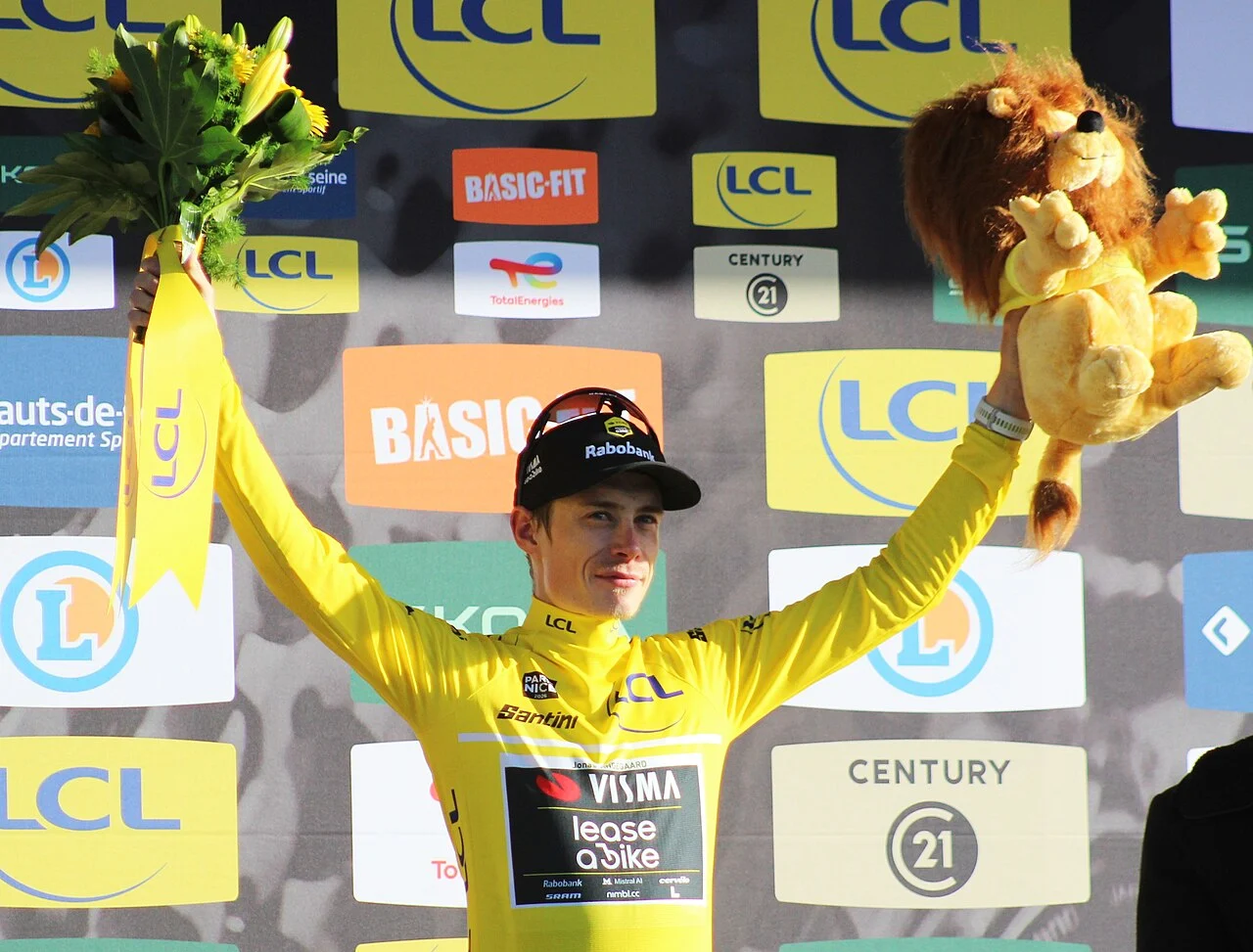
The benchmark is the Giro that Vingegaard won on 31 May 2026. It was 3,459 km long, with 50,000 metres of climbing, a little lighter in the mountains than in 2025. It had a single time trial, the Viareggio-Massa on stage 10, of about 40 km.
The 2024 Giro had far more: 71.8 km in total, including a 40 km stage in Perugia, in the first week. In 2027 the choice changes again: not one long time trial, but two shorter ones, one of them uphill, with the second in doubt between Monza and Vicenza.
For those watching the general classification, in 2026 a grand tour time triallist could make his gains in a single day, over 40 km. In 2027 the gains are split between two different tests, one uphill and one on the flat.
The 2027 Giro does not yet have a total distance or overall elevation gain: until the route is official, the comparison with the 3,459 km and 50,000 metres of 2026 remains open.
The 2026 summit finishes and the great mountains that return
The 2026 Giro had seven summit finishes. The first is Blockhaus on stage 7. Then come Corno alle Scale (5.8 km at 7.7%), Pila (16.6 km at 7.1%), Carì (9 km at 8.9%), Andalo, Piani di Pezzè (4.9 km at 9.8%) and Piancavallo.
Behind the names there are old stories. Blockhaus had already hosted a finish in 2017 and 2022. Corno alle Scale last welcomed the Giro in 2004. At Piancavallo, Marco Pantani won in 1998 and Tao Geoghegan Hart in 2020.
In 2026 almost all the great climbs of the Alps and the Dolomites were left off the route. In 2027 many return: the Mortirolo, the Gavia, Madonna di Campiglio, the Zoncolan.
From the Mugello to Piani di Bobbio: the second week
After Naples and Monte Livata the race continues north. The provisional programme lists Palombara Sabina-Norcia on 18 May and Gualdo Tadino-Scarperia on the 19th, with the stage on the Mugello circuit. On 21 May there is a very hilly stage in Emilia-Romagna, from Borgo Val di Taro to Reggio Emilia.
The summit finish at Zum Zeri, in Tuscany, is expected on 20 May: 23 km of climbing never used by the Giro. The day after the hilly stage, Saturday 22 May, comes the summit finish at Piani di Bobbio, near Bergamo. The last 8 km are close to 10% in gradient.
The second time trial is scheduled for 23 May in Monza: after it comes the rest day, then the real mountains.
Sondrio-Aprica with a double Mortirolo and the Gavia, stage 16
The key day for the general classification is Sondrio-Aprica, stage 16, on Tuesday 25 May, with almost 6,000 metres of climbing. The route goes up the Mortirolo, then the Gavia, at 2,618 m the Cima Coppi, the highest point of the Giro. Then it returns to the Mortirolo, a second ascent by the harder side, the one from Mazzo di Valtellina.
The last climb is Aprica, third category, last used in 2015 on the stage won by Mikel Landa. After two Mortirolo ascents and the Gavia, even a third-category climb weighs heavy.
The next stage offers a breather: the finish is in Negrar, near Verona, in the heart of Valpolicella, the wine country.
Madonna di Campiglio, the Zoncolan and the Rome sprint
Stage 18 on Thursday 27 May is expected to finish at Madonna di Campiglio, in Trentino, where Pantani was thrown off the 1999 Giro over a haematocrit test. A Dolomites stage follows with a night in Austria, in Lienz, then stage 20 finishes on the Zoncolan.
The Zoncolan was last climbed in 2018, when Chris Froome won the stage and laid the foundations of his overall victory. The Giro brings it back on the queen stage on Saturday 29 May, probably from the Ovaro side, which ends in a natural amphitheatre packed with fans. Another possibility is the Priola side.
After the Zoncolan comes the transfer of about 600 km to Rome. On Sunday 30 May, stage 21, the race circles the Colosseum in an evening sprint.
Giro Women 2027 and the big names: Vingegaard, Evenepoel, Seixas and Pogačar
For the Giro d’Italia Women only the dates are known
The 2027 Giro d’Italia Women runs from 29 May to 6 June, and starts on the weekend when the men’s Giro goes to the Zoncolan and Rome. Nothing else is known about the route for now.
Pogačar says no, for Evenepoel it is too early to decide
Tadej Pogačar says he prefers the Giro but considers his participation very unlikely in the 2027 edition. For Red Bull-BORA-hansgrohe, team manager Ralph Denk said it is too early to decide on Remco Evenepoel, and that personally he is not a fan of the route.
Evenepoel comes off a 2026 with 14 wins, including the World time trial title on 20 September and two stages at the Tour de France, where he finished second overall. The two time trials of 2027 are an argument in his favour.
Jonas Vingegaard won the Giro on 31 May 2026, in a season of 12 wins, and abandoned the Tour on 19 July. Paul Seixas, 20, won Il Lombardia on 10 October after finishing fourth at the Tour.
For Seixas the Giro could be the road to the Haute-Savoie World Championships, with the road race on 29 August 2027 on a circuit that repeats the Côte de Domancy 20 times. The Vuelta, meanwhile, moves to 4-26 September precisely to make room for the Worlds.
Story written with the help of Mnemosyne.
Sources
- Cyclingnews, “The Zoncolan, the Mortirolo (twice) and the Gavia – 2027 Giro d’Italia set for classic format with return to host of mythical climbs”.
- Domestique, “Giro d’Italia 2027 – 20km mountain time trial in the Apennines confirmed for first week”.
- Domestique, “Can 2027 Giro time trials tempt Evenepoel into Grand Tour double attempt?”.
- Domestique, “2026 Giro d’Italia route revealed with 40km time trial and reduction in climbing”.
- Domestique, “A mountain time trial, the Mortirolo twice and a return to the Zoncolan – what we know ahead of the 2027 Giro d’Italia route presentation”.
- Photo: MFonzatti, CC BY-SA 4.0, via Wikimedia Commons.
