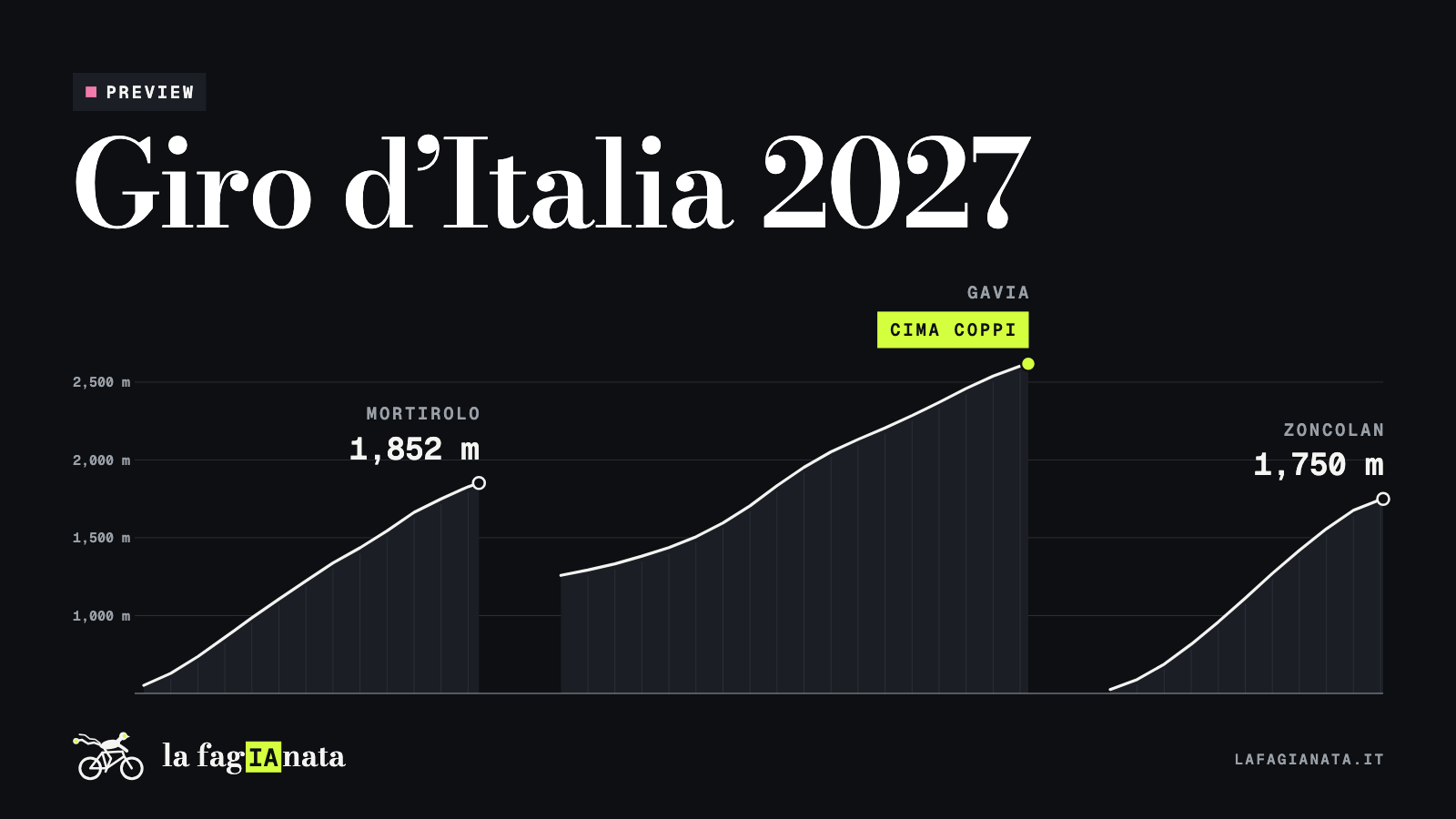
The Mortirolo from its hardest side, then the Gavia, then the Mortirolo again. That is the queen stage sketched out by the previews for the 2027 Giro d’Italia, Tuesday 25 May from Sondrio to Aprica, with almost 6,000 metres of climbing. The Giro, the 110th edition, starts in Trieste on 8 May and finishes in Rome on 30 May. The route is not official: it will be presented in Rome on 3 November, and until then everything should be read in the conditional.
The queen stage: two Mortirolos and the Gavia in one day
It would begin with the first Mortirolo (1852 metres) from the side that starts at Mazzo Valtellina, the steepest. Then the descent into Val Camonica and the climb to the Passo Gavia, 2618 metres, which would be the Cima Coppi of this edition. Down to Bormio, then the Mortirolo again from Mazzo. After the second climb there would remain the descent towards Edolo and the final climb, passing through Corteno Golgi, to Aprica.
Why the Mortirolo from Mazzo is feared
It is 11.3 kilometres at an average gradient of 10.9%. The average, though, hides the point that matters: after the chapel there is a straight at 18%, with about nine kilometres still to go. The first stretch, in the woods, is already at 10%; in the finale the road leaves the trees and climbs through the pastures, where the Pantani memorial stands.
The Giro has included it at least 11 times since 1990. Two ascents on the same day, with the Gavia in between, would be the newest part of the design.
Lombardy: Piani di Bobbio, Monza and the rest day
The queen stage would be preceded by three days that weigh on the legs. On Saturday 22 May, Cantù-Piani di Bobbio, in the province of Lecco: the finish is at 1662 metres, between Valsassina and Val Brembana, and is reached from Valtorta, on the Bergamo side, after other climbs.
Sunday 23 May an individual time trial in Monza, starting and finishing at the Autodromo Nazionale. Monday 24 May is a rest day. In sequence: a long climb, a flat race against the clock, a break, then the Mortirolo. Whoever arrives in Sondrio has already had to choose where to spend their energy.
The final week: Campiglio, Austria and Zoncolan
Wednesday 26 May, Chiari-Negrar, in Valpolicella. Thursday 27, Negrar-Madonna di Campiglio, finishing at 1550 metres, in a resort linked to Marco Pantani. On Friday 28 the race would pass from Trentino into Austria.
Saturday 29 May, Lienz-Monte Zoncolan, summit finish. The Giro has already been up the Zoncolan from Lienz: in 2007 Gilberto Simoni won, in 2011 Igor Anton. In 2018 Chris Froome won there, riding away alone. It would be the last big climb before Rome.
The opening: Trieste, the South and two motor-racing circuits
The race would start on Saturday 8 May with a Trieste-Trieste stage that would touch Slovenia. Then Gorizia-Pordenone and the descent southwards. The Sulmona-Campo di Giove time trial, with an uphill finish, should be the first shake-up of the general classification.
In Naples the finish would be on viale Caracciolo, by the sea; in 2026 it was in piazza Plebiscito. Heading back north, a stage from Castiglione del Lago to the Autodromo del Mugello would give the sprinters a challenge, and on Friday 21 May the Montecatini-Reggio Emilia would be raced. With Monza and Mugello, two motor-racing circuits would feature in the same Giro.
Rome and what remains to be learned
The last stage, on Sunday 30 May, would finish in Rome, at the Fori Imperiali or near the Colosseum. In 2026 Jonathan Milan won in Rome and the Giro went to Jonas Vingegaard.
The total distance, the number of stages and the exact layout of the stages in between remain to be confirmed. On 3 November in Rome we will learn which of these hypotheses hold.
Article written with the help of Mnemosyne.
Sources
- Photo: Fliedermaus at Luxembourgish Wikipedia, CC BY-SA 1.0, via Wikimedia Commons.
- Climb profiles: roads © OpenStreetMap (ODbL), elevations EU-DEM 25 m (Copernicus).
