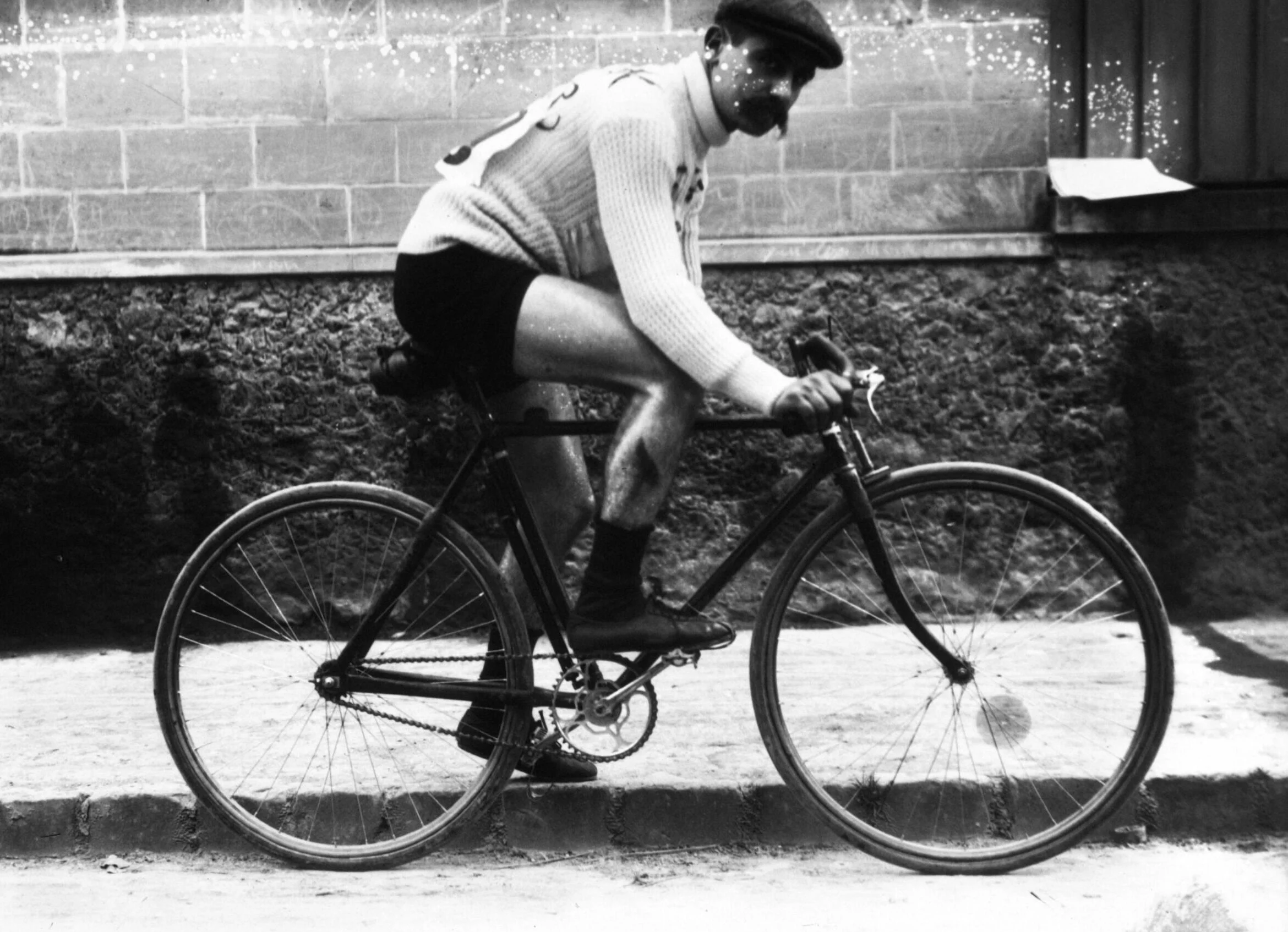
Sixty-three riders started the 1910 Milan-San Remo and four were classified. The first, Eugène Christophe, took twelve hours and twenty-four minutes; the second-placed rider arrived an hour and a minute after him, the fourth more than two hours after. In 2026, on 21 March, Tadej Pogačar beat Tom Pidcock, who was given the same time, and 168 of the 175 starters finished.
Rain, hail, snow
They left Milan at six in the morning on 3 April, for 289.3 km. It was raining; at Tortona the rain turned to hail, and on the Turchino to snow: there were 20-25 cm01 of it on the pass. Some riders, hearing about the snow, went straight home.
In front was Cyrille Van Hauwaert, a Belgian, the 1908 winner. At Ovada he had three minutes; by Masone about thirty riders were left in the race, and they climbed the Turchino partly on foot. Octave Lapize abandoned because of the cold before the top. Van Hauwaert crested first after five hours of racing, with Christophe about ten minutes behind. On the descent he crashed, took shelter in a house and, once he had warmed up, refused to go on.
Trousers in the chain
Christophe, French, 25 years old, was close to frozen at the bottom of the descent. He stopped to warm up in a small hotel for 25-30 minutes; he got dry clothes and a pair of long trousers, and set off again. Before Savona he caught Luigi Ganna, the previous year’s winner, and Pierino Albini. At Savona he led Ganna by fifteen minutes, and stopped again: to eat, and to cut off the trousers, which had caught in his chain.
He reached San Remo alone, after 12h24′02. Legend has it that he was convinced he had taken a wrong turn. They took him to hospital with frozen hands: he stayed three or four weeks, and it took him two years to be the rider he had been.
Four in the result
Ganna came in behind him, 39 and a half minutes down, but he was disqualified for covering part of the course by car. Piero Lampaggi was disqualified for a stretch by train, and Sante Goi arrived after the control had closed. According to the Gazzetta, seven riders reached San Remo. The official result kept 4 of 6303: Christophe, Giovanni Cocchi at 1h01′, Giovanni Marchese at 1h17′ and Enrico Sala at 2h06′.
| 1910 | 2026 | |
|---|---|---|
| Start | Milan | Pavia |
| Kilometres | 289.3 | 298 |
| Starters | 63 | 175 |
| In the result | 4 | 168 |
| Winner’s time | 12h24′00″ | 6h35′49″ |
| Winner’s average | 23.3 km/h | 45.2 km/h |
| Gap to second | 1h01′ | s.t. |
Christophe, known as Cri-Cri, would make the history books twice more. At the 1913 Tour, his fork broken on the descent of the Tourmalet, he walked more than ten kilometres to a forge at Sainte-Marie-de-Campan and repaired it himself, as the rules required. He finished the stage almost four hours down, and the jury gave him a ten-minute penalty as well, later cut to three, because a boy had helped him. At the 1919 Tour he wore the first yellow jersey; on the penultimate stage his fork broke again, and he finished third.
His 1910 time is the second slowest in the history of the race: only Gaetano Belloni took longer, 12h44′09″ in 1917. In 2026 Pogačar’s average was almost double his.
Sources
- La Gazzetta dello Sport, Ciclismo, la Milano-Sanremo più tormentata? Quella del 1910 di Christophe: the 6 a.m. start, 63 starters, Ovada, 25 cm of snow, Lapize’s retirement, the seven finishers, the disqualifications, the result, Cri-Cri, the Tourmalet, 1919.
- Museo del Ciclismo, 3 aprile 1910 – Milano-Sanremo: rain at the start, Ovada, Masone, Lapize’s retirement, the top of the Turchino, the thirty-minute stop, Savona, the trousers in the chain, the seven finishers.
- Wikipedia (it), Milano-Sanremo 1910: distance, starters, result, average speed, snow on the Turchino, the disqualifications of Ganna and Lampaggi, Goi outside the time limit.
- Wikipedia (en), 1910 Milan–San Remo: the 6 a.m. start, Ovada, Masone, the Turchino, Van Hauwaert, Savona, the wrong-turn legend, the hospital.
- Wikipedia (fr), Milan-San Remo 1910: snow, the trousers in the chain, the recovery.
- Milano-Sanremo, official website: The toughest Sanremo ever: 63 starters and 4 classified, hail at Tortona, Christophe’s stop at a hotel.
- CyclingRevealed, 4th Milan-San Remo 1910: snow on the Turchino, Christophe’s stop, Savona, the hospital.
- BikeRaceInfo, 1910 Milano-San Remo: official result, unclassified finishers.
- Wikipedia (it), Milano-Sanremo 1917 and BikeRaceInfo, 1917 Milano-San Remo: Gaetano Belloni’s time.
- Wikipedia (it), Eugène Christophe, Wikipedia (en) and Wikipedia (fr): birth, nickname, the forks of 1913 and 1919, the penalty, the first yellow jersey.
- Wikipedia (it), Luigi Ganna: the 1909 Milan-San Remo.
- giroditalia.it, Tadej Pogacar won Milano-Sanremo 2026: start in Pavia, 298 km.
- UCI, official results of the 2026 Milan-San Remo, in the fagIAnata archive.
Written with the help of Mnemosyne.