Paul Seixas reached Como 48” ahead of Enric Mas and 1’05” ahead of Giulio Ciccone, and aged twenty years and sixteen days01. Those 48” did not build up gradually over the whole day: he took 44 of them in seven kilometres of climbing, on the Civiglio and the second San Fermo; on the descent of the Civiglio he gave back seven, and the other eleven came on the flat before the San Fermo and on the final descent. Saturday evening’s report tells how it happened; here are the numbers showing where.
The Ghisallo, where the race broke
Before the finale there was a long race, and for almost the whole day it was controlled by the break of fourteen02: out front from 12:22 to 16:36, with a maximum lead of 3’13” at 14:16, 119 kilometres from the finish. Behind them the pace was slow on purpose: at the foot of the Giovenzana, this year’s new climb, the peloton was still three minutes down.
Then came the Ghisallo, 8.6 kilometres at 6.2% for 532 metres of climbing, and the race broke there. The fastest on the climb was Quinn Simmons, in 19’19”, with Matteo Jorgenson, Brandon McNulty and Christian Scaroni on his wheel. That is an average of 26.7 km/h, 1,650 metres of climbing per hour, or about 6.6 watts per kilo sustained for nineteen minutes. At 15:21, at the foot of the climb, the peloton was 2’34” down; twenty-five minutes later, at the bottom of the descent, it was 45” down. The break, meanwhile, had gone from fourteen riders to seven.
The day’s highest effort belongs to a domestique
The biggest number of Lombardia 2026 does not belong to a favourite. On the first ascent of San Fermo della Battaglia, 2.7 kilometres at 7.2%, the fastest was Giulio Pellizzari: 6’10”, 26.3 km/h, 1,900 metres per hour, about 7.3 watts per kilo. Pellizzari was not riding for himself: he was working for Remco Evenepoel, had already closed almost single-handed on the counter-attackers on the Ghisallo, and crested the summit with the whole peloton on his wheel. Shortly afterwards, on the Civiglio, he was dropped. He finished thirty-seventh, 7’05” down.
The Civiglio: not an attack, a progression
The Civiglio is 4.2 kilometres at 9.7% with ramps of 14%, and its summit is 16.7 kilometres from the finish: it is the climb where watts per kilo count for the most and air resistance counts for almost nothing03. Seixas lifted the pace at 16:35, a few minutes into the climb. It was not an attack: it was a pace that the others stopped being able to hold, one at a time. First Evenepoel, then Del Toro and McNulty, then Tom Pidcock; Ciccone was the last to let him go, less than two kilometres from the summit.
At the top: Seixas; Ciccone and Mas at 30”; Filippo Zana and Pidcock at 46”; at 1’10” Evenepoel, Ben Healy, Oscar Onley, Michael Storer, Jarno Widar and McNulty. At the finish these numbers disappear, because from fourth to twelfth they are all at 1’20”: the real race lies in those thirty seconds.
On the morning of the race, in “Where it pays to attack at Il Lombardia”, we had tabulated what an attack is worth here: on the Civiglio each extra percentage point of power is worth about seven seconds at the top, 3% more makes 22”, 5% makes 36”. So those 30” over Ciccone and Mas mean about 4% more watts per kilo, for all four kilometres. And 1’10” over Evenepoel’s group means about 10%.
On the descent he gave back seven
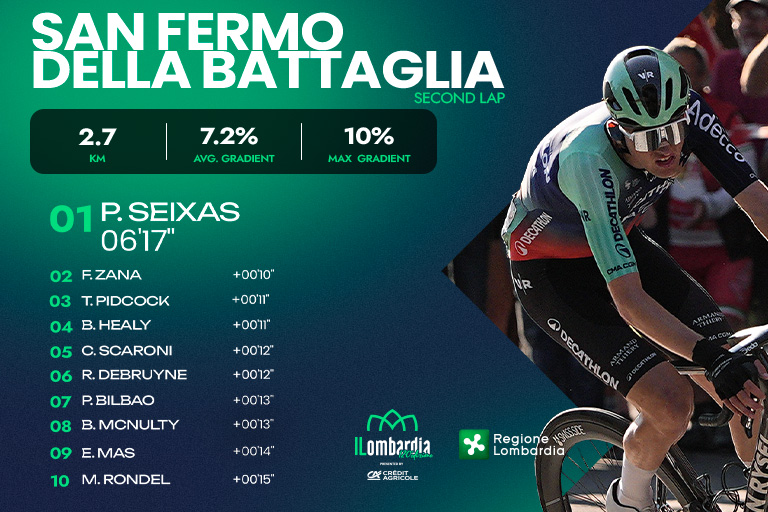
In the same piece we had written that two chasers working together, from the top of the Civiglio to the finish, can take back up to 75 seconds. Ciccone and Mas took back seven: from 30” to 23” at the bottom of the descent, ten kilometres from Como. Then the road went up again, and Seixas opened the gap anew: from 23” at the bottom of the descent to 49” two and a half kilometres from the finish. On the climb of the second San Fermo he took 14 out of Mas: 6’17” against 6’31”. In the morning’s table that lies between the +3% row and the +5% row: about 4%, as on the Civiglio. The rest came on the flat before the climb and on the descent into Como.
The full account: 44 seconds gained on the climbs, 30 on the Civiglio and 14 on the San Fermo; seven given back on the descent of the Civiglio; eleven gained on the flat and on the final descent; 48 at the finish. Seven kilometres of uphill road out of 239.
Who lost, and where
Evenepoel lost Il Lombardia in four kilometres. From the top of the Civiglio to the finish he shed only another ten seconds, from 1’10” to 1’20”, and he was the fastest of the chasers in the finale: his group caught Pidcock and Zana on the San Fermo, and he won the sprint for fourth place. All the damage was done on the Civiglio, in the first minutes of Seixas’s acceleration.
Isaac Del Toro was third wheel at the foot of the climb, behind Adam Yates and McNulty, and was the fagIAno’s second favourite. He answered the first acceleration, cracked two minutes later and never recovered: he finished twenty-eighth, 4’59” down. Of the break, meanwhile, nothing was left: the best of the fourteen is Michael Leonard, twenty-second at 3’53”.
The fagIAno’s receipt
The fagIAno’s probabilities were frozen at 22:53 on 9 October, before the start, and are not touched again. They gave Evenepoel 39.2%, Del Toro 19.8%, Seixas 11.3%: they finished fourth, twenty-eighth and first. Six of our ten favourites finished in the top ten. On the winner, the score we keep is 2.145 against 2.85 for the UCI ranking and 5.159 for someone giving everyone the same probabilities: better than the benchmarks, but with the winner only third on our list, and with the favourite at almost 40%04 finishing fourth. The full receipt is in the race page, with the expected timetable and the one actually lived.
The climbs
| Climb | To the finish | Length | Average | Max | Time | VAM | W/kg | Fastest |
|---|---|---|---|---|---|---|---|---|
| Selvino | 207.1 | 10.1 km | 5.9% | 9% | about 26′46″23′52″–29′41″ | about 1,340 | about 5.24.5–6.0 | the head of the race |
| Valpiana | 153.5 | 10.1 km | 6.2% | 10% | about 25′58″24′37″–28′00″ | about 1,460 | about 5.65.1–6.0 | the head of the race |
| Giovenzana | 102.9 | 3.6 km | 9.2% | 16% | about 13′00″12′00″–14′00″ | about 1,540 | about 5.34.9–5.8 | the head of the race |
| Madonna del Ghisallo | 60.6 | 8.6 km | 6.2% | 14% | 19′19″ | 1,650 | 6.6 | Simmons, Jorgenson, McNulty, Scaroni |
| San Fermo della Battaglia (1st) | 27.1 | 2.7 km | 7.2% | 10% | 6′10″ | 1,900 | 7.3 | Pellizzari |
| Civiglio | 16.7 | 4.2 km | 9.7% | 14% | about 12′16″11′15″–13′17″ | about 1,990 | about 7.06.4–7.7 | the head of the race |
| San Fermo della Battaglia (2nd) | 5.2 | 2.7 km | 7.2% | 10% | 6′17″ | 1,860 | 7.2 | Seixas |
- Selvino about 26′46″ · 5.2 W/kg at 207.1 to go · 10.1 km at 5.9% 4.5–6.0 W/kg range
- Valpiana about 25′58″ · 5.6 W/kg at 153.5 to go · 10.1 km at 6.2% 5.1–6.0 W/kg range
- Giovenzana about 13′00″ · 5.3 W/kg at 102.9 to go · 3.6 km at 9.2% 4.9–5.8 W/kg range
- Madonna del Ghisallo 19′19″ · 6.6 W/kg at 60.6 to go · 8.6 km at 6.2% Simmons, Jorgenson
- San Fermo della Battaglia (1st) 6′10″ · 7.3 W/kg at 27.1 to go · 2.7 km at 7.2% Pellizzari
- Civiglio about 12′16″ · 7.0 W/kg at 16.7 to go · 4.2 km at 9.7% 6.4–7.7 W/kg range
- San Fermo della Battaglia (2nd) 6′17″ · 7.2 W/kg at 5.2 to go · 2.7 km at 7.2% Seixas
In bold the fastest rider’s time, as timed by the organizer. With «about»: our estimate for the head of the race from the live reports, with the range below. Watts per kilo for a 65 kg rider, alone and with no wind; with the weight of the rider at the head of the race when their team declares it. On yellow, the highest watts per kilo of the day.
How we worked
Climbing times: the Ghisallo and both ascents of the San Fermo, timed during the race. Watts per kilo: a physical model with a 65 kg rider and an 8 kg bike, riding alone with no wind. The comparison with the morning uses the table published before the start, not redone afterwards.
News written with the help of Mnemosyne.
Sources
- Standings, climbing times and gaps during the race: RCS Sport, “Il Lombardia, standings”.
- The time on the second San Fermo: RCS Sport, “San Fermo della Battaglia, just a few kilometres from glory”, the fastest climbers infographic.
- Finishing order and official gaps: UCI, results of event 367372.
- Minute-by-minute gaps: the race file, from our live coverage.
- Photo: Kakoula10, CC BY-SA 4.0, via Wikimedia Commons.

Corrected on 11 October 2026: with the official time on the second San Fermo (Seixas 6′17″, Mas 14″ slower) the seconds gained on the climbs are 44, not 56, and the headline now says “almost all of them uphill”; the break was caught at 16:36, not 16:40, Del Toro was dropped at 16:37:57, not 16:43, Seixas accelerated at 16:35, not at the foot of the climb; in the table the Civiglio is about 12′16″, not about 13′, because the earlier estimate measured the break at the foot and Seixas at the top.