The 2027 Giro d’Italia has more summit finishes, the 2027 Tour de France more time-trial kilometres and more climbing. The Giro has seven mountain-top finishes, the Tour three. The time trials measure 56.9 km in Italy and 71 km in France. The elevation gain is 50,250 m against 53,450 m.
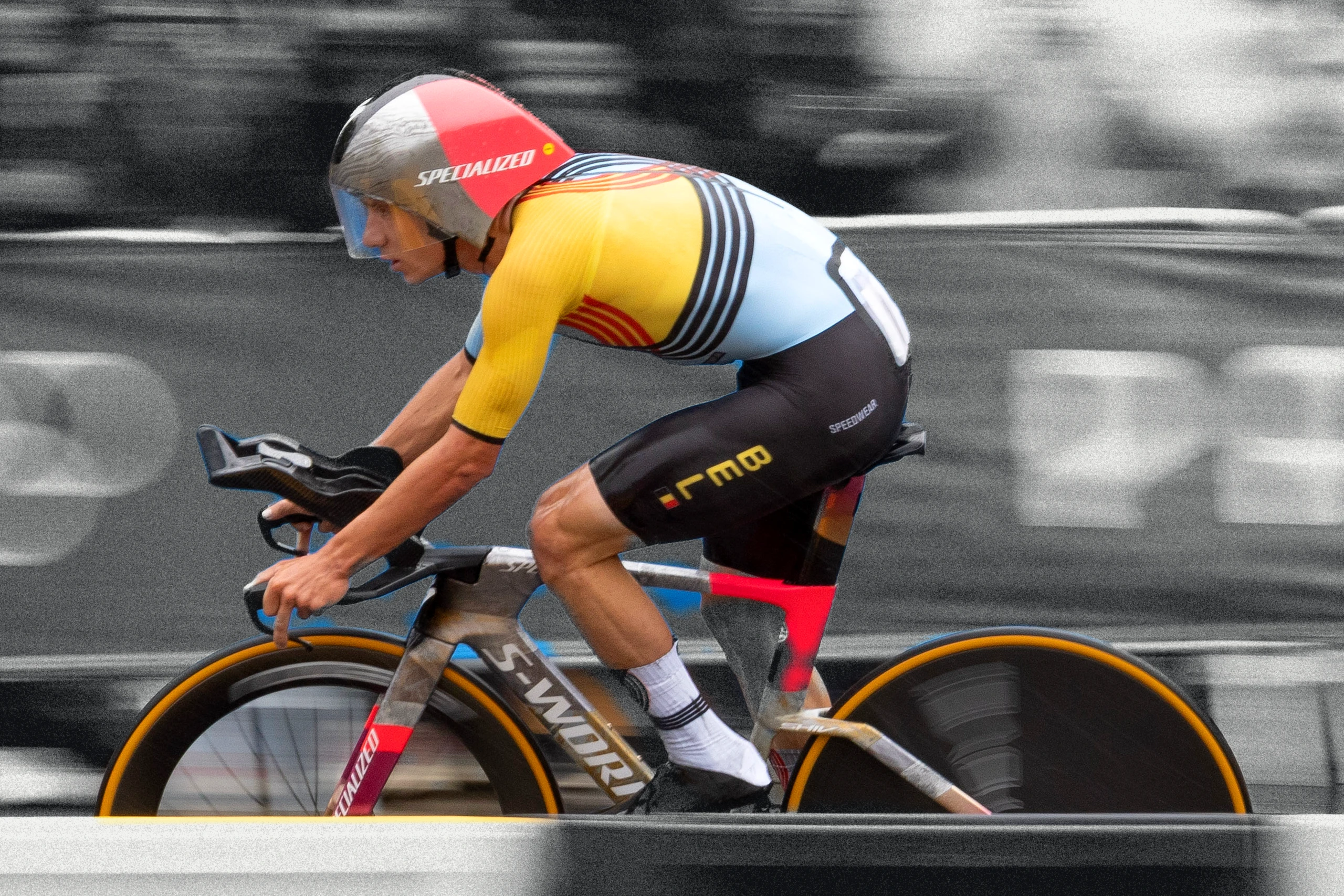
For Remco Evenepoel everything points to the Tour as the race of 2027. The Giro is cut for the Evenepoel of summer 2026, but the extra time-trial kilometres are in France. His programme is not yet known.
The Belgian also has unfinished business with the Vuelta a España and wants to wipe that stain away. In 2027 it cannot be ruled out that he rides all the monuments.
The 2027 Giro d’Italia from Trieste to Rome
The 2027 Giro d’Italia is the 110th edition. It starts in Trieste on Saturday 8 May and finishes in Rome on Sunday 30 May: 21 stages, 3,418.9 km, 50,250 m of climbing. There are 6 sprinters’ stages, 6 hilly ones and 7 mountain stages.
It is the first Giro designed under the leadership of Luca Guercilena, cycling director of RCS Sport. The idea is a route for real riders, with iconic and legendary climbs. Stefano Garzelli, winner of the 2000 Giro, rates it among the finest of the last ten years. Antonio Tiberi, white jersey in 2024, especially likes the first part.
The first stages of the 2027 Giro: Slovenia, puncheurs and a sprint
The race opens with three days for classics riders. Stage 1, Trieste–Trieste over 172 km, crosses the Slovenian border and has three short climbs in the last 40 km, with the descent to the finish. Stage 2, Ljubljana–Koper over 166 km, is run entirely in Slovenia: a sharp climb ends 3 km from the finish, then a fast descent.
The third, Cervignano del Friuli–Possagno over 163 km, has two modest climbs and a false flat towards the line. The pure sprinters wait for stage 4, Argenta–Misano Adriatico over 151 km, with the sprint on the Marco Simoncelli circuit. Stage 5, Filottrano–Sarnano-Sassotetto, 139 km with 3,300 m of climbing, brings the first summit finish: the final climb is 13.1 km long.
The two time trials of the 2027 Giro: one uphill and one flat
The 2027 Giro has two time trials totalling 56.9 km. The first is the Sulmona–Campo di Giove mountain time trial, 19.6 km on stage 7. The second is the flat Monza–Milan, 37.3 km, on stage 15.
They are two very different tests. On the flat, what counts is holding the aerodynamic position and pushing the same power for a long time: it is the terrain of specialists such as Evenepoel. Uphill, what counts is the ratio of watts to weight.
The one at Campo di Giove, however, has about 7 km of climbing, with an average gradient close to 4.4% and a maximum of 9%: it is not a ferocious climb.
Seven summit finishes at the 2027 Giro, not all of them brutal
The summit finishes of the 2027 Giro are seven: Sarnano-Sassotetto, Monte Livata, Zeri (Passo dei Due Santi), Piani di Bobbio/Valtorta, Aprica, Madonna di Campiglio and Monte Zoncolan. The number is the same as at the 2026 Giro.
Compared with the Tour there is less climbing, but the finish is at altitude more often: seven finishes against three. And not all seven are brutal. Those aiming for the overall classification must stay alert several times, even on days that look less hard on paper.
Sondrio–Aprica with the Gavia and Mortirolo, then the Zoncolan
Stage 16, the Sondrio–Aprica, measures 192 km with 5,700 m of climbing. The Passo del Gavia, at 2,618 m, is the highest point of the race. The Mortirolo is climbed twice, with gradients of 12%.
The Zoncolan is climbed from Ovaro, from 530 m to 1,730 m in 10.1 km, at an average gradient of 11.9%. The Ovaro side had not been used since 2018, in the Giro won by Chris Froome.
The 2026 Giro had ended with two mountain stages in close succession: stage 19, with 5,000 m of climbing, and stage 20, with 3,750 m. In 2027 that saw-tooth final week is gone.
The 2027 Tour de France from Edinburgh to Paris
The 2027 Tour de France is the 114th edition. It starts in Edinburgh on Friday 2 July and finishes in Paris on Sunday 25 July: 21 stages over 3,479 km. Christian Prudhomme presented the route in Paris on 22 October 2026.
It has only three summit finishes, but more climbing than four of the last five editions: there is a lot of climbing, but the stage does not always end at the top. Stage 1 finishes in Carlisle and there are six probably flat stages. The Pyrenees decide the race in the final week, with the hardest stage on paper at the Col du Portet.
Tadej Pogačar is chasing a fourth Tour in a row and a sixth overall: he would surpass Jacques Anquetil, Eddy Merckx, Bernard Hinault and Miguel Induráin. It ends with the triple ascent of Montmartre for the third year in a row, on the 116 km final stage in Paris.
71 km of time trials: the 2027 Tour has more than any edition since 2012
The 2027 Tour de France has 71 km of individual time trials across two stages. It had not happened since 2012, when the distance was 101 km and Bradley Wiggins won. The first test is 38 km, flat, from Blois to Chambord (stage 7). The second is 33 km in Toulouse (stage 16).
The Toulouse course is almost flat, with about 200 m of climbing. In the second half, however, there is a short, steep climb, 800 m at 12.5%.
At the 2025 Tour the two time trials told very different stories. Over the 33 km at Caen, Pogačar lost 16 seconds to Evenepoel. On the Peyragudes mountain time trial, by contrast, he gained minutes. A flat time trial is decided by a few seconds, an uphill one can decide an entire Tour: in 2027 the two tests are almost flat.
Grand Colombier, Les Saisies and Col du Portet: three summit finishes
The summit finishes of the 2027 Tour are three: Grand Colombier (stage 9), Les Saisies (stage 11) and Col du Portet (stage 18). The Grand Colombier, 17.4 km at an average gradient of 7.1%, is also the first mountain-top finish of the race.
Stage 18, Pau–Col du Portet, measures 174 km with 5,400 m of climbing and goes over the Soulor, Tourmalet and Hourquette d’Ancizan. The Portet is 16 km long at 8.7% and was last seen in 2021, when Pogačar beat Vingegaard and Richard Carapaz. It comes two days after the Toulouse time trial.
Among the other stages to note: stage 8, the longest, 224 km from Bourges to Le Creusot with five categorised climbs; stage 14, Montpellier–Mende, 199 km with 4,300 m of climbing; stage 19, with the Col de Marie Blanque 20 km from the finish in Laruns.
The 2027 Giro and Tour against the 2026 editions
The 2027 Tour has about 14 km more time trialling and 3,200 m more climbing than the Giro, but four fewer summit finishes. The comparison with 2026 shows where the two routes are moving.
The 2026 Giro, the 109th edition, started in Bulgaria and was run from 8 to 31 May. It measured 3,459 km with 49,150 m of climbing, seven summit finishes and a single time trial, 40.2 km, flat, between Viareggio and Massa (stage 10). That test was made for the specialists Evenepoel, Roglič and Vingegaard: in Italy only Vingegaard turned up, and he won the Giro.
The 2026 Tour had a 19 km team time trial in Barcelona (stage 1) and a 26 km individual time trial (stage 16), with a 9.7 km climb at an average of 4.3%. There were five summit finishes: Gavarnie-Gèdre, Plateau de Solaison, Orcières-Merlette and Alpe d’Huez twice.
The Giro therefore changes on the time trial, which becomes double, and on the finale without the saw-tooth. The Tour goes from 26 to 71 km of individual time trialling and from five to three summit finishes.
What changes for Evenepoel
Evenepoel’s 2027 programme is not yet known. What can be said comes from the routes and from what he did in 2026.
The Tour weighs more for Evenepoel
The 2027 Giro suits the Evenepoel of summer 2026, but the weight of the season will probably fall on the Tour, because of the extra time-trial kilometres. The Belgian has unfinished business with the Vuelta a España and it cannot be ruled out that in 2027 he rides all the monuments.
In 2026 he won 14 races: among them the Amstel Gold Race, the Clásica San Sebastián, the Grand Prix Cycliste de Québec, the European road race title on 4 October and the world time-trial title on 20 September, the fourth of his career. At the Tour he won stages 15 and 16 and finished second overall.
At Chambord, after a first week without big mountains, he can take the first yellow jersey of his career: he has already won three time trials at the Tour. The sticking point is the Alps. On the Grand Colombier, staying with Pogačar is difficult, and getting close to him in the Toulouse time trial will take a lot.
The Giro without the big names
Pogačar has all but ruled out the 2027 Giro: he is going for a sixth Tour. The programmes of Vingegaard and Evenepoel are unknown, and for Evenepoel the Tour will take priority anyway, because there are two time trials there too. He rode the Giro in 2023: he won stages 1 and 9 and did not start stage 10.
Without the three of them the race can open up, as in 2025, when Simon Yates won. Two time trials and a less brutal final week could even allow the Giro-Tour double. The possible names are Paul Seixas, who has hinted he might come to Italy, Isaac del Toro, Giulio Pellizzari, Florian Lipowitz, Mattias Skjelmose, Juan Ayuso and Enric Mas, the Vuelta champion.
Story written with the help of Mnemosyne.
Sources
- Sporza, «Is de volgende Giro nu wel of niet zwaarder dan de Tour en wat doet Remco Evenepoel? “Het accent zal liggen op Frankrijk”».
- Giro d’Italia (RCS Sport), «From Trieste to Rome: Giro d’Italia 2027 Route Unveiled».
- Domestique, «Giro d’Italia 2027 route revealed: Two time trials and the return of the mighty Zoncolan».
- Cyclingnews, «Tour de France 2027 route unveiled with British start, 71km of time trials, and a brutal queen stage as highlights».
- Cyclingnews, «Giro d’Italia 2027 route – A comprehensive guide to all 21 stages».
- Photo: UrsusArctosArctos, CC BY 4.0, via Wikimedia Commons; editing: la fagIAnata.
