VAM, or average ascent speed, is the speed at which you climb, measured in metres of ascent per hour. The term comes from Michele Ferrari, who introduced it in 1994. It is calculated by dividing the elevation gain by the time in hours: 800 metres in 45 minutes is 1,067 m/h. It allows different climbs to be compared without assumptions about weight, watts or bike. On the Madonna del Ghisallo it is measured the same way for a rider who does it in 19′19″ and one who takes half an hour.
In brief
- Above a gradient of about 5%, the W/kg of the rider-plus-bike system are roughly VAM divided by 367: a rule of thumb, not a measurement.
- To compare different climbs, Ferrari’s rule subtracts 50 m/h for every extra point of average gradient: it is a convention, not a law of physics.
- On the same climb, with a tailwind, two attempts can differ by 5-10% in VAM.
- The climbs of Il Lombardia 2026 cover very different VAMs, from long, gentle ascents to short, steep ramps, and the number alone is not enough to rank them.
The formula in one line
The formula can be written two ways, and they say the same thing. In hours: VAM = elevation gain (m) / time (hours). In minutes, which is how times are actually read: VAM = (metres climbed × 60) / minutes of climbing.
A second, longer example: 1,200 metres in 55 minutes gives 1,309 m/h. The result does not say how long the road is or how long the effort lasts. It says how fast, vertically, you leave the valley floor: more a lift than a speedometer.
Two pieces of data are needed to calculate it, and no power meter. The elevation gain is read off a map, the time off a watch; weight, bike and watts do not come into it. At Il Lombardia 2026 the Madonna del Ghisallo has 532 metres of elevation gain, and Simmons, Jorgenson, McNulty and Scaroni climbed it in 19′19″. Anyone who rides the same road, in any time, gets their own number with the same line.
From metres to watts per kilo
VAM does not measure power, but it sits close to it. To see how close, start from what holds a climber back.
Why power-to-weight matters uphill
A rider’s power is split three ways: against gravity, against rolling resistance and against the air. The gravity share depends on the mass of rider plus bike, on the acceleration of 9.81 m/s², on the gradient and on the speed. Uphill it is the main obstacle: more power for the same weight, or less weight for the same power, and you climb faster.
That is why two very different riders can go level. One pushes 350 W at about 91 kg, the other 218 W at about 57 kg: 3.85 W/kg for both, and they climb together. VAM is linearly related to watts per kilo, and can be used to estimate them when weight is not known precisely. It remains a rough estimate, not a measurement.
The sums with our 280 watts
The conversion to watts per kilo of the rider-plus-bike system is W/kg = VAM / (200 + 10 × gradient in %), and the gradient shifts the result. At 1,000 m/h you get 3.84 W/kg at 6% and 3.33 W/kg at 10%: for the same VAM, the steeper climb requires fewer watts per kilo. Take an amateur who holds 280 watts.
The sums
- 280 W ÷ 65 kg = 4.3 W/kg
- 280 W ÷ 75 kg = 3.7 W/kg
The legs are the same, the numbers are not: only weight separates them, which is why the VAM of two amateurs with the same engine does not match. The calculation, moreover, concerns the system. With a bike of about 8 kg, the watts per kilo of the body alone are higher by about 0.2-0.3.
For the same watts, gradient changes VAM
Speed makes the difference
If VAM followed gravity alone, a given power would give the same number on every gradient. In practice it does not. With 300 W and 80 kg in total, that is 3.75 W/kg, at 5% you go at eighteen kilometres an hour and VAM is 900 m/h; at 10% you go at 10 km/h and VAM is 1,000 m/h.
Speed makes the difference. On the ramp you go slowly, the air weighs less and a larger share of the effort goes into beating gravity, which is exactly what VAM counts. Ignoring air and friction, the power needed to sustain a given VAM would be the same on every gradient: gravity does not look at the road, it looks at the height gained.
Effort goes to gravity, and below 5% the air muddies things
The picture can be read in how the effort is divided. On the flat the air takes almost everything; as the road rises gravity takes over, while rolling and transmission stay small. A high VAM is therefore easier to reach on steep gradients.
Below a 5% gradient the air muddies the picture. At high speed, and perhaps in a slipstream, VAM stops isolating climbing ability and starts also to tell you how sheltered you were. That is why the cleanest comparisons are on real climbs, where the fight is mostly against weight.
The same climb, your time
To take VAM to your local climb you need the elevation gain, which the map or GPS gives, and the time from a stopwatch. The number is most useful against yourself: the same climb repeated over the months tells you whether your form is improving, because the slope does not change. It is most revealing on gradients of 6-15%; below that, the air complicates things.
The Climb Stopwatch does the translation on the Ghisallo: from time to watts per kilo, as a range, with the professionals’ marker to show where you fall.
Madonna del Ghisallo
8.6 km 6.2% average 532 m elevation gain
Enter a rider’s climbing time: the watts per kilo, with their range, and the VAM will appear here.
3.8 W/kg approx.
between 3.5 and 4.1 W/kg
- VAM
- 1,064 m/h
- Average speed
- 17.2 km/h
- Power
- about 285 W
| Power | Time | Speed |
|---|---|---|
| 5.0 W/kg | 23'36" | 21.9 km/h |
| 5.5 W/kg | 21'50" | 23.6 km/h |
| 6.0 W/kg | 20'23" | 25.3 km/h |
| 6.5 W/kg | 19'10" | 26.9 km/h |
| 7.0 W/kg | 18'07" | 28.5 km/h |
How we calculate it
Physical model by Martin and colleagues (1998): gravity, rolling resistance, air (on the rider and on the wheels) and bearing friction, at constant speed and gradient. Central assumptions: bike and equipment 8.0 kg, rolling resistance 0.0040, aerodynamic drag area 0.32 m², drivetrain efficiency 97.6%, air density 1.09 kg/m³ (average altitude 1,000 m), no wind.
The range is the result with all the favorable assumptions (drafting, a 1.5 m/s tailwind, a light bike) and with all the unfavorable ones (riding alone, a headwind, a heavier bike). These estimates are typically off by 6–10% (Millet, Tronche and Grappe, 2014): that’s why we never give a single number. A rider who surges and eases off spends a little more for the same time. VAM, the meters climbed in an hour, is a measurement instead: it depends only on elevation gain and time.
A caution on comparisons: outdoors on a climb you push harder than on rollers, so the VAM of an ascent and the power of an indoor test do not coincide.
Where an amateur stands
A scale makes sense only if you say where it applies: continuous climbs of over 20 minutes, with a gradient between 6 and 10%. There the bands are fairly stable.
The riders’ bands
Recreational cyclists climb at 400-700 m/h, club riders at 700-1,000 m/h. Trained amateurs reach 1,000-1,300 m/h, and above 1,200 that usually means about 4.0 W/kg or more.
Elite amateurs and professionals of smaller teams sit at 1,300-1,500 m/h, with 4.5-5.5 W/kg.
These are orders of magnitude, not steps. They hold for long, regular climbs; on a short ramp or a gentle road the same rider gets a different number, and it must be read according to the type of climb.
One kilo less is worth different seconds
On the Ghisallo one kilo less, for the same watts, gains everyone seconds, but not the same ones. A kilo is a fraction of the total weight, and that fraction applies to the time spent on the climb. Someone climbing for half an hour has more minutes in which to bank it than someone taking under twenty.
The sums
- Amateur, 75 kg and 280 W: 30′15″; one kilo less: 29′58″.
- Professional, 65 kg and about 435 W: 19′19″; one kilo less: 19′09″.
One kilo is worth 18 seconds to the amateur and 10 to the professional.
Then there is speed. The amateur stays longer on the climb and goes slower: the air weighs less and weight counts for almost everything. The professional goes faster and part of his effort goes into the air, which weight does not see. That is why the kilo gives more seconds to the amateur. It remains a calculation at fixed watts: if the lost kilo also takes away power, the advantage disappears.
The professionals on the climbs of Il Lombardia
Il Lombardia 2026 put seven climbs under the stopwatch, and VAM puts them all on the same line. The one with the highest number is not the longest nor even the hardest on the legs: it is a short ramp. The number has to be read with the gradient beside it.
| Climb | Time | VAM (m/h) | W/kg |
|---|---|---|---|
| Selvino | 26′46″* | 1.340 | 4,5-6,0 |
| Valpiana | 25′58″* | 1.460 | 5,1-6,4 |
| Giovenzana | 13′00″* | 1.540 | 4,9-5,8 |
| Madonna del Ghisallo | 19′19″ | 1.650 | 6,0-7,6 |
| San Fermo della Battaglia (1st) | 6′10″ | 1.900 | 6,7-8,3 |
| Civiglio | 12′16″* | 1.990 | 6,4-7,7 |
| San Fermo della Battaglia (2nd) | 6′17″ | 1.860 | 6,6-8,1 |
Long climbs and short ramps
Selvino and Valpiana are long, gentle climbs: regular gradient, an effort that can be paced, the lowest VAM in the table. Giovenzana and Civiglio are the opposite, a few kilometres with the road rearing up to double figures, and VAM jumps.
The reason is physical before it is athletic. At low speed the air weighs little and almost all the power goes into lifting body and bike; moreover, on a ramp you can push harder, because it lasts less. But W/kg do not rise in step with VAM: part of the jump is the gradient, not the legs.
There is a Ferrari rule for making different climbs comparable: you subtract a little VAM for every extra point of average gradient. It serves to put the numbers back on the same scale. It is a handy convention, not a law of physics.
The Ghisallo and the two San Fermo passes
On the Madonna del Ghisallo the time is official, but the watts estimate is the most fragile: the climb is taken fast, the air weighs over 15% and the estimate is weak. The range is an order of magnitude, not a verdict.
The San Fermo della Battaglia is short, about six minutes, and for six minutes you can push far harder than for twenty-five. The W/kg ranges, over the two passages, therefore sit higher than on the long climbs. This does not say those riders are stronger on the San Fermo: it says they had to last less time there.
A climb tells you how hard you pushed that day, not how long you could sustain it for an hour.
What the studies say
No study measures VAM: scientific papers talk about power, durations and masses. Around our number, though, they say things that clarify its weight.
Long climbs decide stages
At the 2016 Giro d’Italia, among nine riders of a WorldTour team, in the mountain stages the powers over durations beyond 10 minutes count, as in time trials. In flat and rolling stages short efforts weigh more. The load says so too: a mountain stage is worth 329 TSS, against 280 for rolling ones and 217 for flat ones.
Races are often won by a decisive effort that comes after hours of racing, for example 45 minutes on a hors catégorie climb with the finish at 2,000 metres. That VAM comes from legs already worn out.
Weight counts for less than W/kg suggest
Dividing watts by kilos assumes that weight counts in direct proportion. That is not always so: the optimal mass exponent falls below 1 when gradients are gentle and speeds high, so weight matters less than W/kg suggest. On steep, slow climbs it approaches 1, or exceeds it.
It follows that W/kg and VAM are mainly tools for steep climbs, where gravity does almost everything. Professionals, after all, produce their best maximal mean powers on average gradients of about 6-7%: precisely what the climbs of Il Lombardia have in abundance.
Where the number is not enough
VAM is a ratio of metres to hours, and like all ratios it hides what lies above and below the line. It is worth knowing where it stops telling the truth.
The wind changes the test
Headwind, heat, rain, road surface and bike change the VAM that is possible. A headwind weighs less on steep, sheltered climbs. VAMs derived from power curves are lowered to account for wind and rolling resistance.
With a tailwind VAM rises a lot, and the same climb, repeated on different days, can give numbers so far apart that your form seems to have changed when it was the air that changed. The same goes for slipstream: with other riders ahead the air weighs less, and VAM rewards it without saying so.
Altitude lowers everything
In a stage race at altitude, maximal mean power over 4 and 10 minutes was lower by 4.1% and 7.8% between 1,000 and 2,000 metres, and by 17.4% and 15.0% above 3,000. Between 2,000 and 3,000 metres the mean power of the stages was lower by 12.4%.
Thin air, however, offers less resistance, and the authors suggested that speed might hold up better than power. For those not acclimatised, sustainable power drops by about 5-8% for every 1,000 m.
The formulas disagree
The gradient factor for converting VAM to W/kg varies from source to source, and the results are slightly different: it is an estimate, and with a bike of a different weight the sums shift again.
The sources do not even agree on how gradient affects things at equal power. VAM ranks climbs, it does not say who was stronger: that is why, on the Ghisallo, it is worth looking at the gradient too.
News written with the help of Mnemosyne.
Sources
- Friel J., “The Cyclist’s Training Bible”, 5th ed., VeloPress, 2018.
- Allen H., Coggan A.R., McGregor S., “Training and Racing with a Power Meter”, 3rd ed., VeloPress, 2019.
- Horvath M., Andersson E.P., “Optimal body mass normalization of power output for accurate prediction of estimated cycling performance over complex time-trial courses”, Frontiers in Sports and Active Living, 2025, PMID 40901017, doi:10.3389/fspor.2025.1599319.
- Vinetti G., Rossi H., Bruseghini P., Corti M. et al., “Functional Threshold Power Field Test Exceeds Laboratory Performance in Junior Road Cyclists”, Journal of Strength and Conditioning Research, 2023, PMID 36692223, doi:10.1519/JSC.0000000000004471.
- Sanders D., Heijboer M., “Physical demands and power profile of different stage types within a cycling grand tour”, European Journal of Sport Science, 2019, PMID 30589390, doi:10.1080/17461391.2018.1554706.
- Valenzuela P.L., Leo P., Mateo-March M., Gallo G., Seiler S., Mujika I., “UCI Sports Nutrition Project: The Science of Successful Cycling Performance”, International Journal of Sport Nutrition and Exercise Metabolism, 36(3):174-186, 2025, PMID 41265433, doi:10.1123/ijsnem.2025-0157.
- Garvican-Lewis L.A., Clark B., Martin D.T., Schumacher Y.O. et al., “Impact of Altitude on Power Output during Cycling Stage Racing”, PLoS ONE, 2015, PMID 26629912, doi:10.1371/journal.pone.0143028.
- “Il Lombardia 2026”, the race page: the climb times and our watts per kilo.
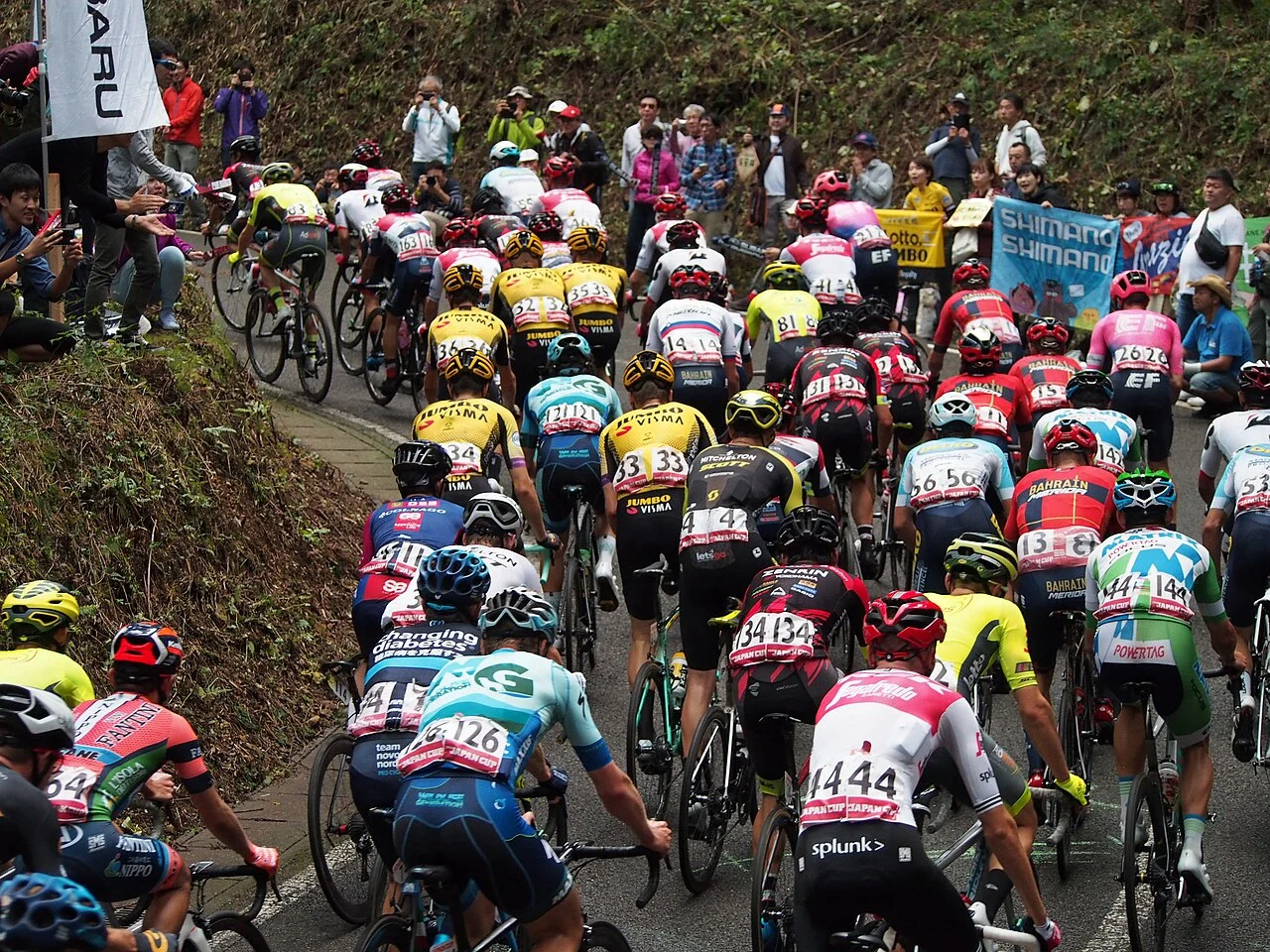
- Photo: Fukumoto, CC BY-SA 4.0, via Wikimedia Commons; adapted by la fagIAnata, under the same licence.
