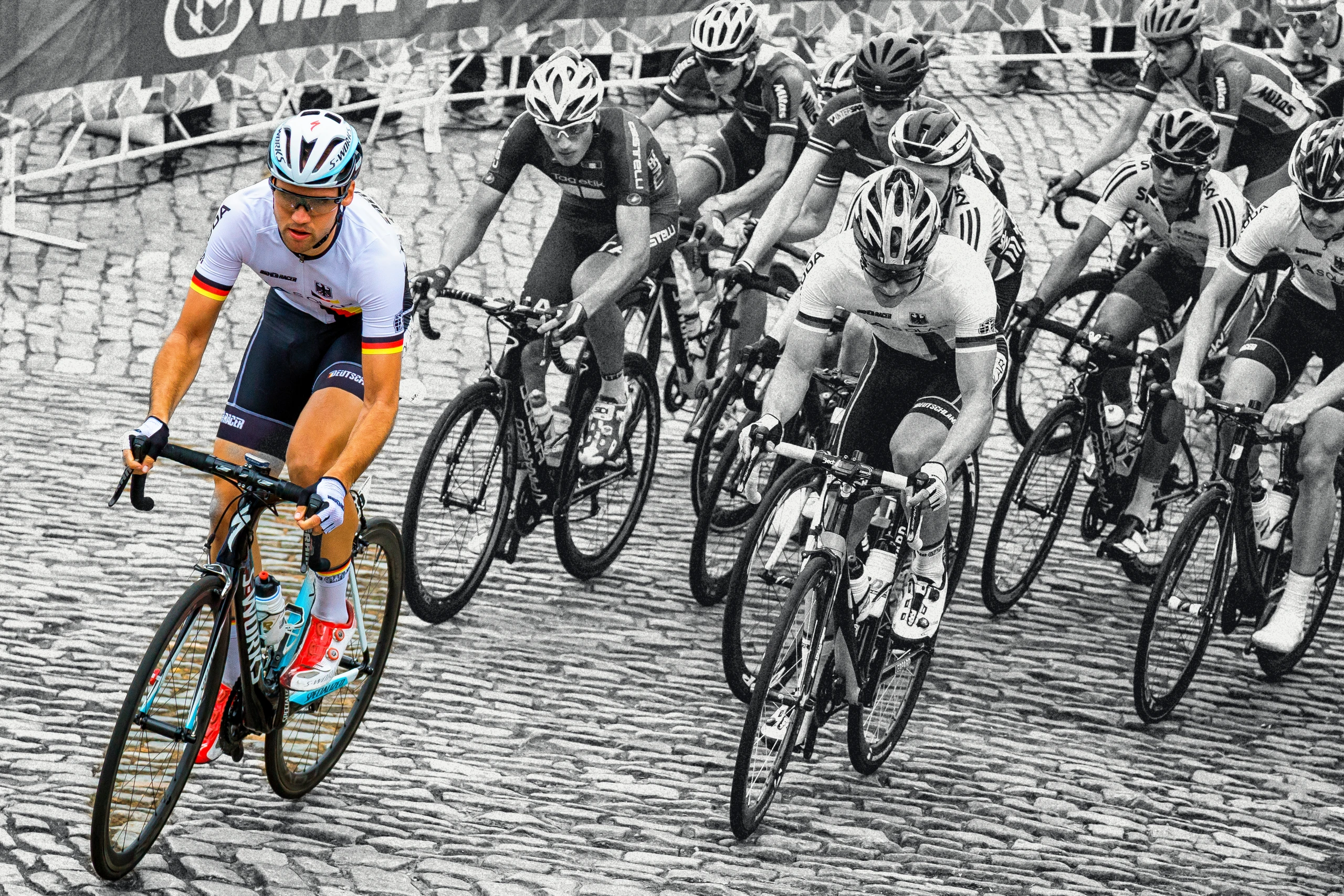
At Il Lombardia 2026 Simmons, Jorgenson, McNulty and Scaroni reached the top of the Ghisallo together, after a climb ridden at almost 27 km/h. A trained amateur, on the same road and the same bike, takes more than ten minutes longer.
The difference lies not in the watts in their legs, but in how many they have for every kilo they must carry to the top.
In brief
- Watts per kilo is power divided by body weight: on a climb it puts riders of different sizes on an equal footing.
- The value to compare is threshold, the effort you can sustain for about an hour.
- Between a strong amateur and a professional the gap is wider in watts per kilo than in watts.
- One kilo less is worth more seconds to a slow climber than to a fast one.
- On the flat and in time trials weight matters less, because the air is what holds you back.
From scratch: watts per kilo in one line
The watt, the measure of push
The watt measures power, that is, how much work is done in a second. On a bike it is read by the power meter, in the pedals, the crank or the hub, dozens of times a second.
On its own, though, the watt does not tell you how fast you go uphill. You need to know how much mass that power has to lift.
Power divided by weight
You take average power and divide it by body weight in kilograms. The result is written W/kg. The same engine, fitted to two different bodies, gives two different numbers.
The sum
- 280 W ÷ 65 kg = 4.3 W/kg
- 280 W ÷ 75 kg = 3.7 W/kg
Two riders with the same ratio climb level, even if one is much bigger than the other. The bigger one pushes more watts but has more kilos to haul up, and the two effects cancel out.
Why the climb is the kingdom of the kilo
On a road that goes uphill the main force holding you back is gravity, and gravity pulls in proportion to mass. On the flat gravity no longer does any work and the air does the braking, which depends on the surface exposed to the wind more than on weight.
The chart shows where the watts of the amateur in our examples go when the road tilts: even on a flyover-type gradient gravity takes the biggest share of the effort.
Who is pedalling: where an amateur and a professional stand
Threshold, the number to divide
In front of “4 W/kg” the first question is for how long. For five seconds a sprinter reaches enormous numbers; over an hour everyone drops. The reference for comparisons is functional threshold, FTP: the highest power you can sustain for about an hour.
Few people really measure it over an hour. Usually you do a 20-minute all-out test and take 95% of it: it is an estimate, not a measurement.
The ranges in the studies
The studies put professionals’ FTP at around 5-6 W/kg and that of trained amateurs between 3 and 5. In between are the young riders hoping to turn pro: in 61 riders aged 15 to 22, the FTP estimated in the lab averaged 3.93 W/kg in under-17s, 4.48 in juniors and 4.91 in under-23s.
Each category adds about half a watt per kilo, and the under-23s are already at the doorstep of the professional range.
The same climb, two times
The most concrete way to grasp the number is to put it on a climb. The Madonna del Ghisallo at Il Lombardia 2026 was climbed at the front by Simmons, Jorgenson, McNulty and Scaroni, with an official time; the amateur in our examples climbs it on the same bike and with his own engine.
The curve shows how many minutes each watt per kilo takes. The higher the ratio, the fewer minutes each extra tenth is worth: a slow rider gains a lot from every improvement, while one who is already fast struggles for a few seconds.
In the Cronometro delle salite you enter your own time and weight, and read off the ratio that produces them.
Madonna del Ghisallo
8.6 km 6.2% average 532 m elevation gain
Enter a rider’s climbing time: the watts per kilo, with their range, and the VAM will appear here.
3.7 W/kg approx.
between 3.5 and 4.1 W/kg
- VAM
- 1,055 m/h
- Average speed
- 17.1 km/h
- Power
- about 280 W
| Power | Time | Speed |
|---|---|---|
| 5.0 W/kg | 23'36" | 21.9 km/h |
| 5.5 W/kg | 21'50" | 23.6 km/h |
| 6.0 W/kg | 20'23" | 25.3 km/h |
| 6.5 W/kg | 19'10" | 26.9 km/h |
| 7.0 W/kg | 18'07" | 28.5 km/h |
How we calculate it
Physical model by Martin and colleagues (1998): gravity, rolling resistance, air (on the rider and on the wheels) and bearing friction, at constant speed and gradient. Central assumptions: bike and equipment 8.0 kg, rolling resistance 0.0040, aerodynamic drag area 0.32 m², drivetrain efficiency 97.6%, air density 1.09 kg/m³ (average altitude 1,000 m), no wind.
The range is the result with all the favorable assumptions (drafting, a 1.5 m/s tailwind, a light bike) and with all the unfavorable ones (riding alone, a headwind, a heavier bike). These estimates are typically off by 6–10% (Millet, Tronche and Grappe, 2014): that’s why we never give a single number. A rider who surges and eases off spends a little more for the same time. VAM, the meters climbed in an hour, is a measurement instead: it depends only on elevation gain and time.
What a kilo is worth
Taking off a kilo raises the ratio without touching the watts. On the Ghisallo, with watts unchanged, the sum is this.
The sum
- Amateur, 75 kg and 280 W: 30′15″; one kilo less: 29′58″.
- Professional, 65 kg and about 435 W: 19′19″; one kilo less: 19′09″.
A kilo is worth 18 seconds to the amateur and 10 to the professional.
The kilo is a bigger gift to the amateur than to the champion, on one condition: losing weight at the cost of power lowers the ratio instead of raising it.
For number lovers: what the professionals say
The climbs of Il Lombardia 2026
The ratio a professional holds depends on how long the effort lasts. The shorter and steeper the climb, the higher the number; the longer it gets, the lower it falls.
San Fermo della Battaglia is the shortest: Pellizzari climbs it in 6′10″ on the first passage, Seixas in 6′17″ on the second, at a VAM of about 1,900 and 1,860 m/h. Selvino and Valpiana are ten kilometres long: the head of the race takes around 26 minutes on them and the VAM drops to about 1,340 and 1,460 m/h.
The Ghisallo is the climb in our examples but also the most fragile to read. There the leaders were climbing at almost 27 km/h: at that speed the air takes about one-sixth of the effort and the bunch’s slipstream matters, so the estimate rests on less solid assumptions. Times and climbs are in the Il Lombardia 2026 profile, and how we measure them in the methodology.
Same start line, amateurs and elite
At the Tour of Lithuania 2024 a team of five elite riders and one of five high-level amateurs raced the same stage race, after the same lab tests. At the peak of the incremental test the elite riders pushed 466 W, the amateurs 429.
The amateurs, however, weighed more, 85.7 kg against 78, and in watts per kilo the gap widened: 6.01 against 5.01. Less than 10% in watts, one-fifth in watts per kilo. Maximal oxygen uptake tells the same story: 64.4 against 53.9 ml/kg/min.
The amateurs finished all five stages, but spent longer above critical power, the level beyond which fatigue builds up quickly: they were in the wind more often and spent energy to avoid being dropped, while the elite riders saved themselves for the decisive moments.
How much the riders weigh
At the Vuelta 2020, among 36 professionals, climbers weighed on average 63.9 kg, all-rounders 67.1 and flat specialists 67.4, all around one metre eighty tall. Between the climbers and the others the height is the same and about three kilos separate them: at 400 watts that makes about three-tenths of a watt per kilo.
The number that remains after hours
A ratio measured when fresh does not tell the whole story. In the Monuments between 2021 and 2023, the top five finishers lost power in the first part of the race, but beyond 60 kJ per kilo of accumulated work (about 3,900 kJ for a 65 kg rider, four or five hours of racing) they held it steady. Those who finished between sixth and thirtieth kept fading.
It happens to amateurs too. Twenty trained cyclists, after pedalling 1,000 kJ at 80% of their 20-minute power, lost on average 10.1% in the 20-minute test and 10.8% in the 5-minute one.
And those who held up best were not those with the most oxygen or the highest threshold in watts per kilo: resistance to fatigue is a separate number, which the ratio measured when fresh does not see.
Where watts per kilo is not enough
On the flat the kilo weighs less
The ratio counts weight in full. On a climb that works; on the flat, where the air does the braking, weight should count for less. An analysis of the 2024 Grand Tour time trials, with five simulated typical riders, looked for how much weight to count: dividing by full weight means exponent 1, ignoring it means 0, that is, raw watts. On the Giro time trial the best value is about 0.49, on the hillier one at the Tour about 0.61; over ten completely flat kilometres it falls to about 0.38.
That is why a big rouleur can beat a climber in a time trial with a lower ratio: on the flat absolute power counts.
One day is not threshold
A climbing time tells you how hard someone pushed that day, with that day’s wind, slipstream and tiredness. That is why our estimates are always ranges and never a single decimal.
The same goes for the amateur: a twenty-minute climb is not threshold, which is a one-hour effort.
Sources
- Marín-Pagán C., Dufour S., Freitas T.T., Alcaraz P.E., “Performance Profile among Age Categories in Young Cyclists”, Biology 10(11):1196, 2021.
- Cesanelli L., Conte D., Ylaite B., Rønnestad B.R., Lagoute T., Venckunas T., Zambolin F., “Physical performance and tactical experience: determinants of competition outcomes in amateur vs. elite cyclists. A descriptive study from the UCI Tour of Lithuania”, Frontiers in Physiology, 2026.
- Sánchez-Jiménez J.L., Javaloyes A., Barranco D., Peña-González I., Moya-Ramón M., Mateo-March M., “Role-Specific Performance Profiles of Professional Cyclists in a Grand Tour”, European Journal of Sport Science, 2026.
- Javaloyes A., Sánchez-Jiménez J.L., Peña-González I., Moya-Ramón M., Mateo-March M., “The Role of Cadence and Torque in Fatigue-Related Power Output Decline in Cycling’s Grand Monuments”, Sports 13(11):406, 2025.
- Barsumyan A., Soost C., Shyla R., Graw J.A., Bliemel C., Burchard R., “Durability as an independent parameter of endurance performance in cycling”, BMC Sports Science, Medicine and Rehabilitation, 2025.
- Horvath M., Andersson E.P., “Optimal body mass normalization of power output for accurate prediction of estimated cycling performance over complex time-trial courses”, Frontiers in Sports and Active Living, 2025.
- Martin J.C., Milliken D.L., Cobb J.E., McFadden K.L., Coggan A.R., “Validation of a mathematical model for road cycling power”, Journal of Applied Biomechanics 14(3):276-291, 1998.
- “Il Lombardia 2026”, the race profile: the climb times and our watts per kilo.
- Photo: Mobilus In Mobili, CC BY-SA 2.0, via Wikimedia Commons; processing: la fagIAnata.

Written with the help of Mnemosyne.