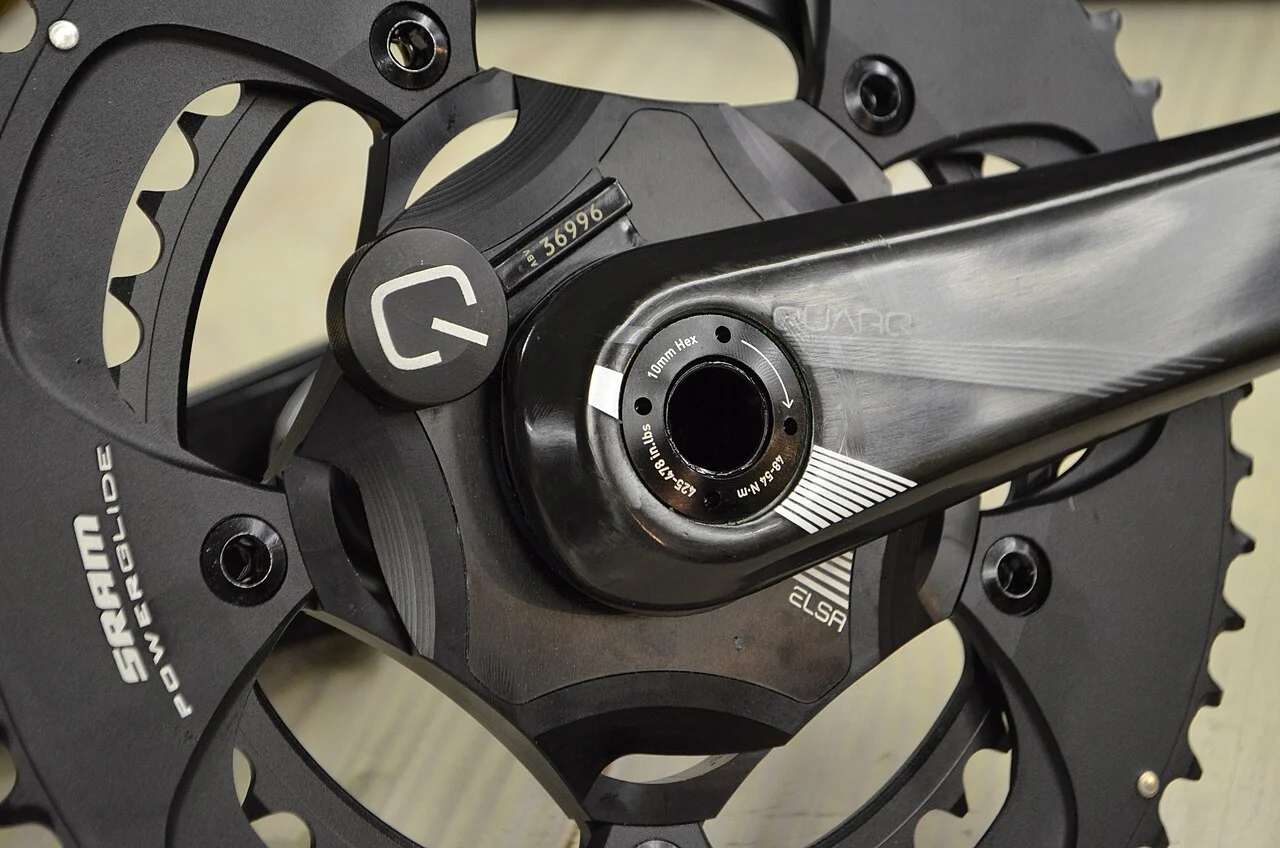
FTP, or functional threshold power, is the highest power you can hold in a quasi-steady state for about an hour. Above it, fatigue arrives much sooner; just below it, you keep going far longer. In practice it is estimated from a 20-minute test: take the average power and work out 95% of it, that is, knock off 5%.
In brief
- The hour is not a law of physics: threshold power can be held for anywhere from 30 to 70 minutes, depending on the person.
- The ramp test lasts about 25 minutes including warm-up and cool-down, far less than the good hour the 20-minute test takes.
- In trained cyclists FTP can sit at 80-82% of power at VO2max.
- The most-cited authors suggest 6-8 tests a year; the textbook protocols call for one every 3-6 weeks.
It matters because it gives everyone the same practical definition. From it you work out training zones, compare one rider with another and talk about the same thing without going near a laboratory: all you need is a bike with a power meter and a road.
The pros’ threshold can be read off the climbs of Il Lombardia 2026, starting with Selvino: how far above it and how far below, and who climbs it in more than half an hour?
FTP in one line
FTP is a practical definition, created to cut the laboratory out of the picture. A review from the early Noughties counted more than 30 scientific definitions of threshold; FTP offers just one, the same for everyone. The number is in watts, the power you push through the pedals, and it is read by the power meter. Physiologically it resembles the lactate threshold.
That prolonged time, an hour, is not a law of physics. How long you can sustain that power depends on the person, and the best trained hold it for longer. In the power-duration model the point where the curve flattens can correspond to a maximal effort of 45, 60 or 75 minutes. The hour is a convenient convention, not a boundary.
The sums
- 280 W ÷ 65 kg = 4.3 W/kg
- 280 W ÷ 75 kg = 3.7 W/kg
The number in watts, on its own, says little: on a climb you work against gravity, and what you weigh counts. With an FTP of 280 W, an amateur of 65 kg and one of 75 kg are not the same cyclist, because the lighter one has more watts for every kilo to carry uphill. That is why FTP is compared in watts per kilo.
The 20-minute test
The 95% estimate from the 20-minute test is the most widely used. You make a maximal effort, take the average and subtract a portion.
Five minutes flat out, then twenty on the flat
The best-known protocol begins with three high-cadence repeats and 5 minutes flat out, which open up the legs and use up some of the anaerobic capacity. Then comes a recovery and the 20 minutes on flat ground at the highest average possible: start slightly below and finish hard over the last 3.
Other protocols add detail. The road is flat or uphill up to 3%, after 3-5 days of easing off. The start is controlled, at a perceived effort of 7 out of 10 for the first 5 minutes, and the pace is reassessed every 5 minutes with small adjustments. Cadence sits between 85 and 95 rpm, and the whole session lasts about an hour with 30 minutes of warm-up. The most common mistake is starting too hard.
Why you subtract 5%
The reduction is there because twenty minutes contain more anaerobic capacity than an hour, and that share cannot be found at a pace held for a full hour. The 5% is not the same for everyone: someone with a lot of anaerobic capacity may need to subtract 7% or more, while a very aerobic rider may need only 2-3%.
The test sums
- 20-minute average: 305 W.
- Subtract 5%.
- Estimated FTP: 290 W.
Estimated FTP of 290 W
On the number from which to subtract 5%, the textbooks disagree: one starts from average power, another from normalised power.
The ramp test
The ramp test is made of steps: you begin with 5 minutes of warm-up at very low power, then every minute the step gets harder. You do not have to complete the last step.
FTP comes from the best one-minute power, to which a fixed percentage is applied. If you exceed the target in the final minute, the software lowers the result slightly.
It hurts only at the end: the real fatigue arrives in the last 2 or 3 minutes. A carbohydrate-rich meal 3-4 hours beforehand is recommended. To repeat it, the protocols suggest an interval of 4-6 weeks.
The one-hour test and other methods
The ways of estimating FTP run from the most direct to the quickest. The shorter the effort, the more is taken off the average and the less precise the estimate.
| Test | Length of effort | Percentage applied | What you take |
|---|---|---|---|
| One hour | 60 minutes | 100% | Average |
| 30 minutes | 30 minutes | 100% | Average |
| 20 minutes | 20 minutes | 95% | Average (in one textbook, normalised) |
| 8 minutes | 8 minutes, repeated twice | 90% | Average |
| 5 minutes | 5 minutes | 88% | Average |
| Ramp | 1-minute steps | 75% | Best minute |
The one-hour time trial and the six ways of estimating
The one-hour time trial is the most direct measure: it is the very definition of FTP put on the road. It has one weak point: if you start too hard and then fade, the average underestimates the true threshold.
The six ways of estimating FTP run from the simplest to the most complex. The first is the power distribution chart, then comes the steady power that recurs in repeats and the normalised power of races of about an hour. After the one-hour time trial come critical power and, at the bottom, a computer model, mFTP.
The short tests and how often to repeat them
In the 30-minute test the average already counts as FTP. The shorter the effort, the more is subtracted and the less accurate the estimate becomes: at 8 minutes you subtract 10%, at 5 minutes 12%, which is why the 20- or 30-minute tests are the ones recommended among the short ones. The 8-minute test involves two efforts with 10 minutes of recovery in between and the pace reassessed every 2 minutes; the efforts should represent power at VO2max.
The intervals between tests also depend on the method. One suggests a new test every 3-4 weeks, so that the zones stay right. Another puts it every 3-6 weeks, after a recovery break and always on the same flat or gently uphill course.
Others tie the tests to moments in the season: winter, the start of the outdoor season, pre-season, a couple of times in season and after the peak of form.
FTP is not VO2max
FTP and VO2max measure different efforts. VO2max is read over 5 minutes, while FTP is the threshold power.
In trained cyclists FTP can sit at 80-82% of power at VO2max. It is not a rule, it is an order of magnitude: with FTP at 81%, VO2max is reached at about 123.5% of FTP. A typical VO2max session is done at 108-115% of FTP, with 6 repeats of 4 minutes.
The power profile lines up the reference durations: 5 seconds for neuromuscular power, 1 minute for anaerobic capacity, 5 minutes for VO2max, then threshold.
Comparing with the 5 minutes helps show where a person’s margin lies. With a high FTP relative to the 5 minutes it is VO2max that limits improvements in threshold. If FTP is low relative to the 5 minutes, there is room to raise the threshold without touching VO2max.
The pros’ numbers on our climbs
Selvino: a 280 W amateur and the head of Il Lombardia
Selvino, at Il Lombardia 2026, measures 10.1 km with 596 m of climbing and an average gradient of 5.9%. The head of the race climbed it in 26′46″. An amateur of 280 W and 75 kg takes 34′17″.
Selvino
10.1 km 5.9% average 596 m elevation gain
Enter a rider’s climbing time: the watts per kilo, with their range, and the VAM will appear here.
3.7 W/kg approx.
between 3.5 and 4.1 W/kg
- VAM
- 1,043 m/h
- Average speed
- 17.7 km/h
- Power
- about 280 W
| Power | Time | Speed |
|---|---|---|
| 5.0 W/kg | 26'50" | 22.6 km/h |
| 5.5 W/kg | 24'53" | 24.4 km/h |
| 6.0 W/kg | 23'15" | 26.1 km/h |
| 6.5 W/kg | 21'53" | 27.7 km/h |
| 7.0 W/kg | 20'43" | 29.2 km/h |
How we calculate it
Physical model by Martin and colleagues (1998): gravity, rolling resistance, air (on the rider and on the wheels) and bearing friction, at constant speed and gradient. Central assumptions: bike and equipment 8.0 kg, rolling resistance 0.0040, aerodynamic drag area 0.32 m², drivetrain efficiency 97.6%, air density 1.09 kg/m³ (average altitude 1,000 m), no wind.
The range is the result with all the favorable assumptions (drafting, a 1.5 m/s tailwind, a light bike) and with all the unfavorable ones (riding alone, a headwind, a heavier bike). These estimates are typically off by 6–10% (Millet, Tronche and Grappe, 2014): that’s why we never give a single number. A rider who surges and eases off spends a little more for the same time. VAM, the meters climbed in an hour, is a measurement instead: it depends only on elevation gain and time.
A climb of about 27 minutes is not a one-hour effort: the time tells you how hard the rider pushed on that climb, on that day, not where the threshold is. The VAM of the leaders is 1340 m/h; how to calculate it is explained in the VAM guide. To test your own time on Selvino there is the Climb timer.
One kilo less is worth 20 seconds to the 280 W amateur, who would drop to 33′57″, and 15 seconds to the 65 kg professional on 335 W, who would drop to 26′31″.
The pros’ threshold, at least
We write “at least” because the climbs last about 26 minutes, not an hour: the threshold is there or higher. On Selvino it is at least about 4.4-5.7 W/kg. On Valpiana (10.1 km, 6.2% average, 25′58″ estimated from the live feed) it is at least about 4.8-6.2 W/kg.
On the Madonna del Ghisallo (8.6 km, 19′19″ official) it is at least about 5.4-7.3 W/kg, but the climb is fast, air resistance counts for more than 15% and the estimate is weak. The two ascents of San Fermo della Battaglia, of about 6 minutes each, sit well above: six minutes of climbing do not measure a threshold.
The estimates start from a 65 kg rider and should be read as orders of magnitude. The method is explained in How we work.
Where FTP falls short
FTP does not coincide with the lactate threshold
A study of 18 people (12 men and 6 women) compared FTP with maximal lactate steady state, the threshold measured in the laboratory. Power at that threshold was 88.5 ± 4.8% of 20-minute power and 93.1 ± 5.1% of FTP estimated with the 95% rule. Both estimates sat above it.
Ten participants repeated the tests after 7 months of training. The laboratory threshold rose by 12 ± 8 W, while the average of the tests did not. Even using 88% instead of 95%, the variability of the data argues against using the estimate in place of the true threshold.
For those who use a single number for everything (zones, pacing, comparisons), this means that the number is an estimate, and that in the study’s data it did not follow the improvement.
One effort is not enough
FTP, critical power and maximal lactate steady state are highly correlated but are not interchangeable: the limits of agreement between them are too wide. For this reason the authors of a review advise against estimating FTP from a single 8- or 20-minute effort. They propose a sprint and at least three maximal efforts of between 2 and 15 minutes. The 95% of 20 minutes, moreover, overestimated 60-minute power in one study.
In a group of juniors, FTP estimated on an outdoor climb (269 ± 34 W) turned out higher than critical power (236 W) and power at 4 mmol of lactate (233 W), both measured in the laboratory.
FTP remains a handy yardstick, the same for everyone and with no laboratory needed, provided you know what it measures: one effort, on one day, read with a percentage.
Article written with the help of Mnemosyne.
Sources
- Allen H., Coggan A.R., McGregor S., “Training and Racing with a Power Meter”, 3rd ed., VeloPress, 2019.
- Friel J., “The Cyclist’s Training Bible”, 5th ed., VeloPress, 2018.
- Friel J., “Fast After 50”, 1st ed., VeloPress, 2015.
- Inglis E.C., Iannetta D., Passfield L., Murias J.M., “Maximal Lactate Steady State Versus the 20-Minute Functional Threshold Power Test in Well-Trained Individuals: ‘Watts’ the Big Deal?”, International Journal of Sports Physiology and Performance, 2020, 15(4):541-547, doi:10.1123/ijspp.2019-0214.
- Leo P., Spragg J., Podlogar T., Lawley J.S. et al., “Power profiling and the power-duration relationship in cycling: a narrative review”, European Journal of Applied Physiology, 2022, PMID 34708276, doi:10.1007/s00421-021-04833-y.
- Vinetti G., Rossi H., Bruseghini P. et al., “Functional Threshold Power Field Test Exceeds Laboratory Performance in Junior Road Cyclists”, Journal of Strength and Conditioning Research, 2023, PMID 36692223, doi:10.1519/JSC.0000000000004471.
- “Il Lombardia 2026”, the race page: the climb times and our watts per kilo.
- Photo: Glory Cycles, CC BY 2.0, via Wikimedia Commons.
