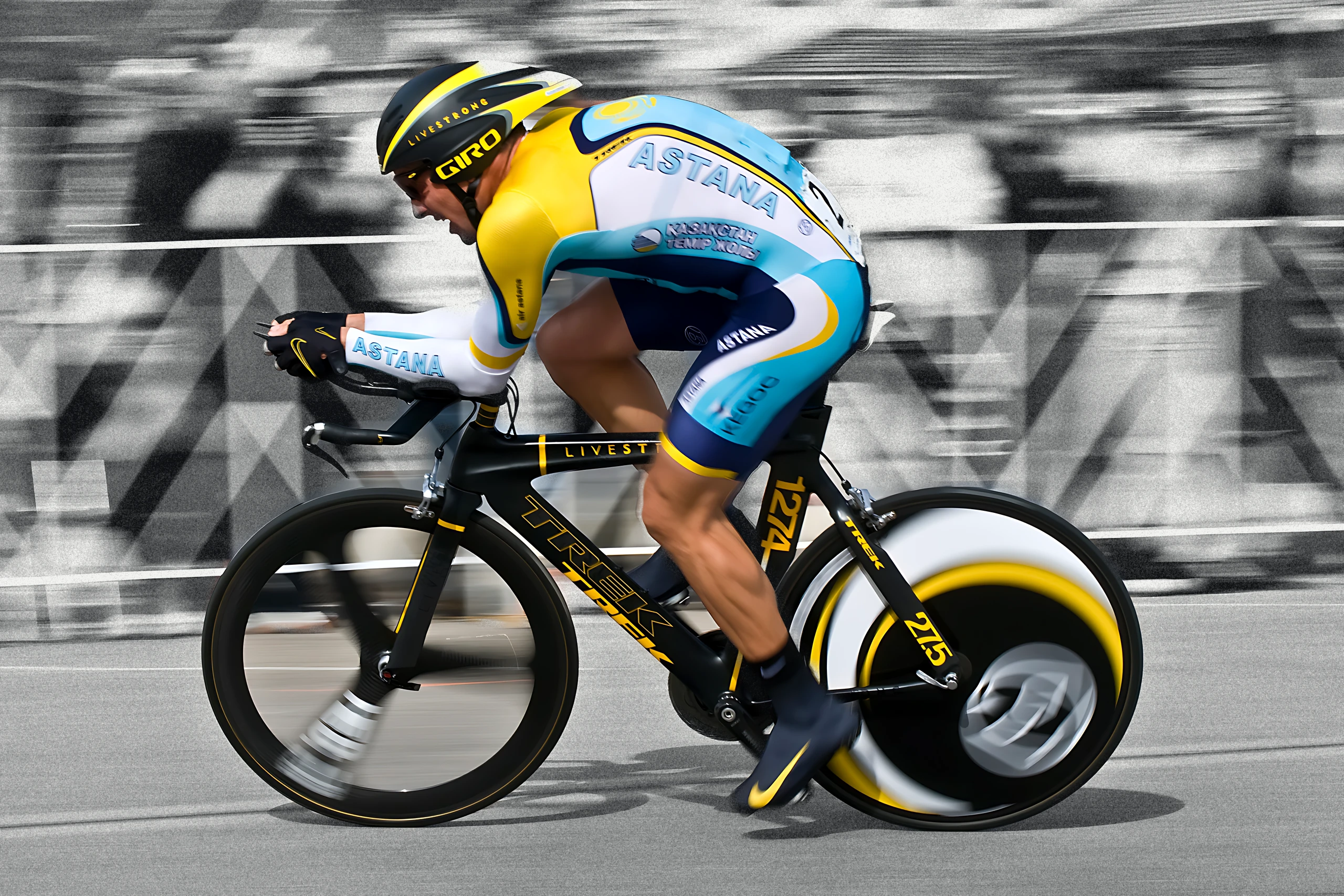
Riding a bike takes watts, and those watts are shared among three resistances: air, tyre rolling resistance and gravity, plus about 2% lost in the drivetrain. How much each takes depends on the gradient. On the flat, the 280 W of a 75 kg amateur carry them at about 40 km/h; at 9%, the same 280 W are worth about 12 km/h.
In brief
- At 0% almost all the watts go into the air; at 9% gravity takes about nine in ten and the air almost nothing.
- One kilo less on the Selvino is worth about 20 seconds to the amateur and about 15 to the professional.
- Air resistance grows with the square of speed and the power needed to overcome it with the cube: that is why speed does not rise in step with power.
- In the peloton, air resistance is significantly reduced.
- Professionals on the climbs of Il Lombardia 2026 sit in watts-per-kilo ranges that start well above 4 W/kg.
Take the Selvino, the climb of Il Lombardia 2026: 10.1 km, 596 metres of climbing, an average gradient of 5.9%. Two riders tackle it: a 75 kg amateur pushing 280 W and a 65 kg professional. Same road, same physics. But on a climb the watts go where on the flat they would not.
Following where they go explains why speed does not follow power. It is the same model that leads from climbing time to watts per kilo when you watch a race.
Watts and watts per kilo in a line
The watt measures power: how much energy per second passes from the legs to the pedals and from there to the road. To compare two different people, power is divided by mass.
The sum
- 280 W ÷ 65 kg = 4.3 W/kg
- 280 W ÷ 75 kg = 3.7 W/kg
The result, watts per kilo, matters because on a climb you have to lift your own body as well as the bike. For the same watts, the lighter rider climbs faster. What counts as an amateur value and what as a professional one is covered in the guide to watts per kilo for an amateur and a professional; the vertical pace, in metres per hour, is explained in the guide to VAM, the average ascent rate.
Martin’s physical model: air, rolling resistance and gravity
The model is simple to state. The power reaching the road is the sum of three terms: what is needed against the air, what is needed against tyre rolling resistance, and the work done against gravity. Gradient, air resistance and rolling resistance determine the speed that this power can deliver.
The model of Martin and colleagues was tested on the road: measured and predicted power were highly correlated and did not differ significantly, with an error of 2.7 W between the two. It is the same model as in our calculations, the one behind the Climb Timer.
That leaves the drivetrain. Between the pedals and the rear wheel, chain and gears lose about 2% in total. Where power is measured changes what you read: a meter on the pedal or crank leaves that loss out, while one on the rear hub already includes it.
Power meters, moreover, have a typical error of about 1-2%. That is why our numbers on climbs are always a range and not a single value; how it is built, case by case, is explained in How we work.
Where the watts go: air on the flat, gravity on the climbs
At constant power, a steeper gradient brings speed down. The slower you go, the less the air weighs; and a larger share of the watts goes into overcoming gravity. How much it changes depends on the mass of rider and bike and on the power produced.
To see it, just look at one rider: the 75 kg amateur on an 8.0 kg bike with his 280 W, at four different gradients.
On the flat, the air takes almost everything
At 0% gravity does no work: the road does not climb, so there is nothing to lift. The biggest share goes to the air, over 80% of the watts, and rolling resistance takes the rest, apart from the 2% lost in the drivetrain.
For the amateur at 40 km/h the air weighs heavily. That is why on the flat you hide behind another rider.
Uphill, gravity rules
At 3% gravity already overtakes the air, and at 6% it is the dominant term. At 9%, the amateur is doing 12 km/h: air resistance weighs very little and almost all the effort goes into hauling 83 kg of rider and bike uphill. Rolling resistance, which does not depend on speed, remains a small, steady term.
The steeper it gets, the more gravity weighs: at a gradient of 15% and 300 W of mechanical power, just 1.6% of the metabolic power goes into overcoming the air. Above 20% the share of power that goes into climbing is already close to one of the total, and even steeper gradients do not gain much time.
What those numbers mean, in metres and in effort, at a double-digit gradient is explained in the guide to what a 10% climb means.
One kilo less is felt mostly on the climbs
Weight matters where gravity rules, and on the Selvino gravity takes almost everything.
The sum
- Amateur, 75 kg and 280 W: 34′17″; one kilo less: 33′57″.
- Professional, 65 kg and about 335 W: 26′46″; one kilo less: 26′31″.
One kilo is worth 20 seconds to the amateur and 15 to the professional, with an 8.0 kg bike.
The calculation on the Selvino shows it with the two protagonists: same kilo, different seconds. The amateur gains a little more than the professional.
The scale of a long climb is set by the Everesting at 15%, the feat of climbing the height of Everest in a single day. In the example from the model of Swinnen and colleagues, one extra kilo of mass costs almost 5 minutes over the whole route.
And the kilo is not only the body’s: the mass that climbs is the rider’s plus the bike’s. Taking a kilo off the bike counts the same as taking it off the person.
Speed and power do not grow together
Rolling resistance ignores the speedometer: the resistance of the tyres on the asphalt is the same at 12 or at 40 an hour. The air is another story. Its resistance grows with the square of speed, and the power needed to overcome it grows with the cube, because the resistance must be multiplied again by the speed.
On the flat this sum is cruel: going a little faster costs many watts, because almost all the effort is already against the air. On a climb the sum almost disappears. You go slowly, the air weighs little, and the extra watts go into lifting the rider and the bike.
Take two riders with the same power, one on the flat and one at 9%: they do not go at the same speed, and the same share of their watts does not end up in the same place either. For the same reason a gain in power does not become an equal gain in speed: it depends on where you ride.
In the work of Martin and colleagues, within the ranges tested, speed varies linearly as the model’s parameters change.
The slipstream: why you spend less in the bunch
In large groups riders spend much of the race together and air resistance is significantly reduced.
The model of Chico-Vázquez and Griffiths puts power spent, air and the risk of crashing in a breakaway on the same scale. The result is that in the elite, success depends as much on reducing risk as on producing power.
The slipstream acts on the air term, which weighs a lot on the flat and little on steep ramps.
The Selvino with the watts of an amateur and a professional
The times come from the Selvino at Il Lombardia 2026: 10.1 km, 596 m of climbing, 5.9% average gradient. The head of the race climbed it in 26′46″, at a VAM of 1340 m/h, which with Martin’s physical model means about 4.5-6.0 W/kg for a 65 kg professional.
A 75 kg amateur pushing 280 W would instead take 34′17″. Almost eight minutes’ difference: it is not only the watts, weight also enters the sum, because on a climb every kilo must be lifted to the top. Anyone familiar with VAM, the average ascent rate can redo the calculation themselves.
Selvino
10.1 km 5.9% average 596 m elevation gain
Enter a rider’s climbing time: the watts per kilo, with their range, and the VAM will appear here.
3.7 W/kg approx.
between 3.5 and 4.1 W/kg
- VAM
- 1,043 m/h
- Average speed
- 17.7 km/h
- Power
- about 280 W
| Power | Time | Speed |
|---|---|---|
| 5.0 W/kg | 26'50" | 22.6 km/h |
| 5.5 W/kg | 24'53" | 24.4 km/h |
| 6.0 W/kg | 23'15" | 26.1 km/h |
| 6.5 W/kg | 21'53" | 27.7 km/h |
| 7.0 W/kg | 20'43" | 29.2 km/h |
How we calculate it
Physical model by Martin and colleagues (1998): gravity, rolling resistance, air (on the rider and on the wheels) and bearing friction, at constant speed and gradient. Central assumptions: bike and equipment 8.0 kg, rolling resistance 0.0040, aerodynamic drag area 0.32 m², drivetrain efficiency 97.6%, air density 1.09 kg/m³ (average altitude 1,000 m), no wind.
The range is the result with all the favorable assumptions (drafting, a 1.5 m/s tailwind, a light bike) and with all the unfavorable ones (riding alone, a headwind, a heavier bike). These estimates are typically off by 6–10% (Millet, Tronche and Grappe, 2014): that’s why we never give a single number. A rider who surges and eases off spends a little more for the same time. VAM, the meters climbed in an hour, is a measurement instead: it depends only on elevation gain and time.
The rest is a game to play with your own time. Anyone who has climbed the Selvino, or a similar climb, can put their result into the Climb Timer and read the range of watts per kilo that comes out, to compare with the head of the race.
The professionals’ numbers on the climbs of Il Lombardia 2026
On the shorter climbs the ranges are higher
The comparison with the professionals holds only where the climb is measured. At Il Lombardia 2026 these are the Selvino, the Valpiana, the Giovenzana, the Civiglio and the two passages over the San Fermo della Battaglia. On the Civiglio, 4.2 km at 9.7%, the head of the race is at about 6.4-7.7 W/kg; on the San Fermo della Battaglia, 2.7 km, it reaches about 6.6-8.3 W/kg.
The number shows the effort of that day, not the threshold
It reads like this: the shorter the climb, the higher the value. Each of these numbers shows how hard a rider pushed that day, not his maximum. The threshold, the effort of about an hour, sits lower and is written “at least”: on the Selvino at least about 4.4-5.7 W/kg.
The Madonna del Ghisallo figure is a weak estimate: you climb fast, and the air weighs more than 15%. For this reason we draw no conclusions from it. Among these climbs there are no women’s races, so there is no comparison to make.
To understand how to get from these values to training zones there is the guide to power zones; for the difference between the effort of a climb and threshold, the one onFTP.
Where the number is not enough
The model explains a lot, but not everything. Riding position, altitude and the body’s efficiency shift the calculations in ways that studies struggle to measure, and on which they do not always agree.
Standing on the pedals the air weighs more, but on a climb it costs less
Pedalling out of the saddle exposes a larger frontal area than sitting. But the weight of this extra resistance falls with speed: on a steep climb, where you go slowly, pedalling standing costs less in aerodynamic terms.
At altitude the advantage of thinner air depends on speed
The thinner air at altitude reduces resistance, but the advantage outweighs the drop in VO2max only when speed is high. The men’s hour record, 55.089 km at 15.3 m/s, was set at 1800 m above sea level. On a climb, where you go slowly, the drop in VO2max prevails.
Efficiency on climbs: studies do not agree
Gross efficiency on a climb is perhaps slightly lower than on the flat, but the reduction seems small. Arkesteijn and colleagues found 0.3 and 0.4% less at 8% than at 4% and on the flat; Nimmerichter and colleagues 1.3% less at 5.1% than at 1.1%. Leirdal and Ettema, up to 11%, found no differences.
Studies on climbing efficiency do not agree, which is why our numbers are ranges.
Story written with the help of Mnemosyne.
Sources
- Martin J.C., Milliken D.L., Cobb J.E., McFadden K.L., Coggan A.R., “Validation of a mathematical model for road cycling power”, Journal of Applied Biomechanics, 1998, 14(3):276-291, doi:10.1123/jab.14.3.276, PMID 28121252.
- Swinnen W., Laughlin E., Hoogkamer W., “Everesting: cycling the elevation of the tallest mountain on Earth”, European Journal of Applied Physiology, 2022, doi:10.1007/s00421-022-05032-z, PMID 36064982.
- Chico-Vázquez J., Griffiths I.M., “A mathematical model for optimal breakaways in cycling: balancing energy expenditure and crash risk”, Royal Society Open Science, 2025, doi:10.1098/rsos.250972.
- “Il Lombardia 2026”, the race page: the climb times and our watts per kilo.
- Photo: Anita Ritenour from Santa Maria, CA, USA, CC BY 2.0, via Wikimedia Commons; editing: la fagIAnata.
